- Forgotten Lives of Oxfordshire
- Posts
- Those fatal gee-gees
Those fatal gee-gees
by Julie Ann Godson
Most middle-class sporting men of the Victorian era would bet on horse-racing. Gambling involving games of chance like cards or dice relied on luck, whereas skill, knowledge, and careful analysis of previous results might give the betting man an advantage. Up-to-date information was essential, but before the invention of the telegraph, information was available only at the race course itself. The roll-out across Britain of the telegraph service enabled instant nationwide dissemination of odds and results, allowing the village-based sporting man to ruin himself with greater efficiency.
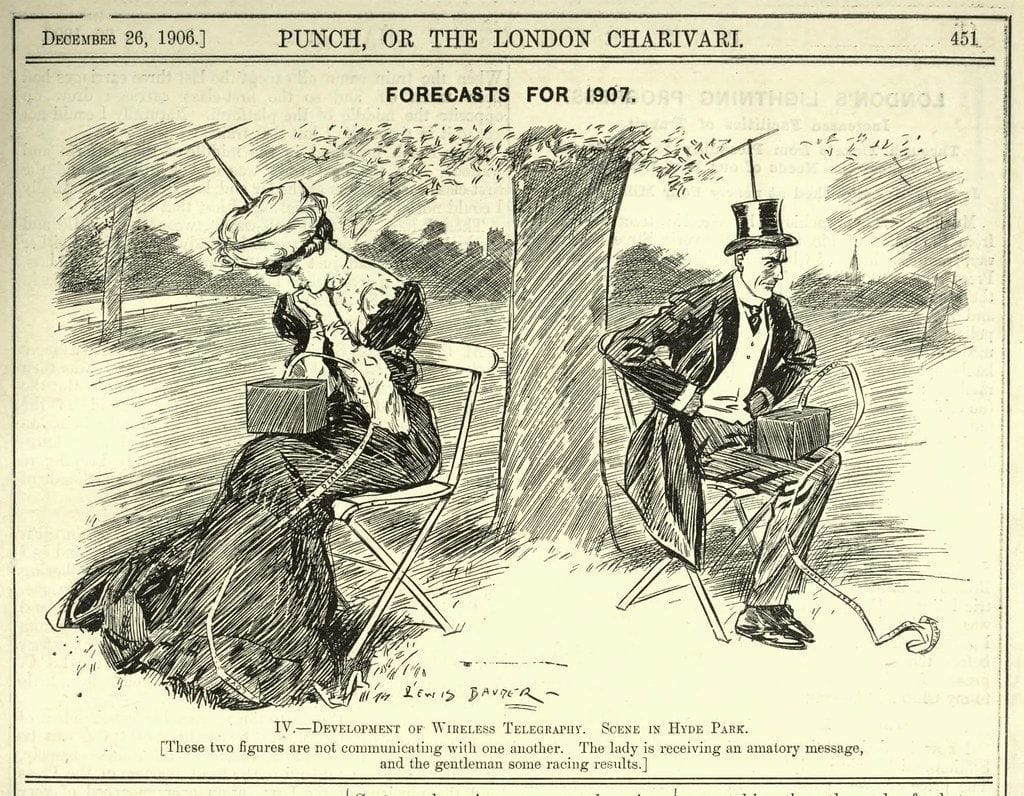
The different uses to which men and women put the new technology
HENRY ARTHUR CAMERON Atkinson came into the world with all of life’s advantages: a comfortable family background, parents determined to help him rise in life, and a brain good enough to qualify him for a place at the University of Oxford. So how come he was found alone in his handsome house in Weston on the Green in 1900, stone dead from swallowing poison at the age of 42?
Arthur, as he was known in the family, grew up at the agreeable but modest Saltwell Dean Cottage in Gateshead, now the Nine Pins Inn.1 His father was a provisions merchant specialising in Danish produce (bacon, cheese, etc), and he was sufficiently well off to provide both a live-in maid and a nurse to help his wife with Arthur’s baby sister, Edith.

Saltwell Dean Cottage in Gateshead, now the Nine Pins
In January 1877 Arthur matriculated at Exeter College in Oxford, aged 18.2 Is this where his troubles started? The son of a Gateshead shopkeeper, overnight he was launched in to a social group almost all of whom would have enjoyed larger allowances from their fathers than he did. Unlike the sons of clergymen and country gentry by whom he was mostly surrounded, Atkinson came from “trade” and was therefore decidedly lower middle class. And yet, if he was the sort who wished to blend in, he would have to adopt some of their more expensive pastimes. Keeping a horse in town, hunting, or giving private dinner parties in one’s rooms were out of his reach, but one pastime that might, just might, yield more than it cost was betting.
Gambling on games of chance such as dice relies entirely on luck, and not on skill; it was the occupation of the lower orders. Betting, on the other hand, involved sleek horses, dapper outfits and a mysterious air of secret knowledge and expert calculation – much more gentlemanly. There had been horse-racing at Port Meadow since the late seventeenth century, but betting was not officially recognised until 1859, when space on the course was allotted for the use of bookmakers. So well did they flourish that in 1877, the year of Arthur Atkinson’s arrival in Oxford, a regulation was introduced forbidding the use of “extravagant costume” to attract punters.3
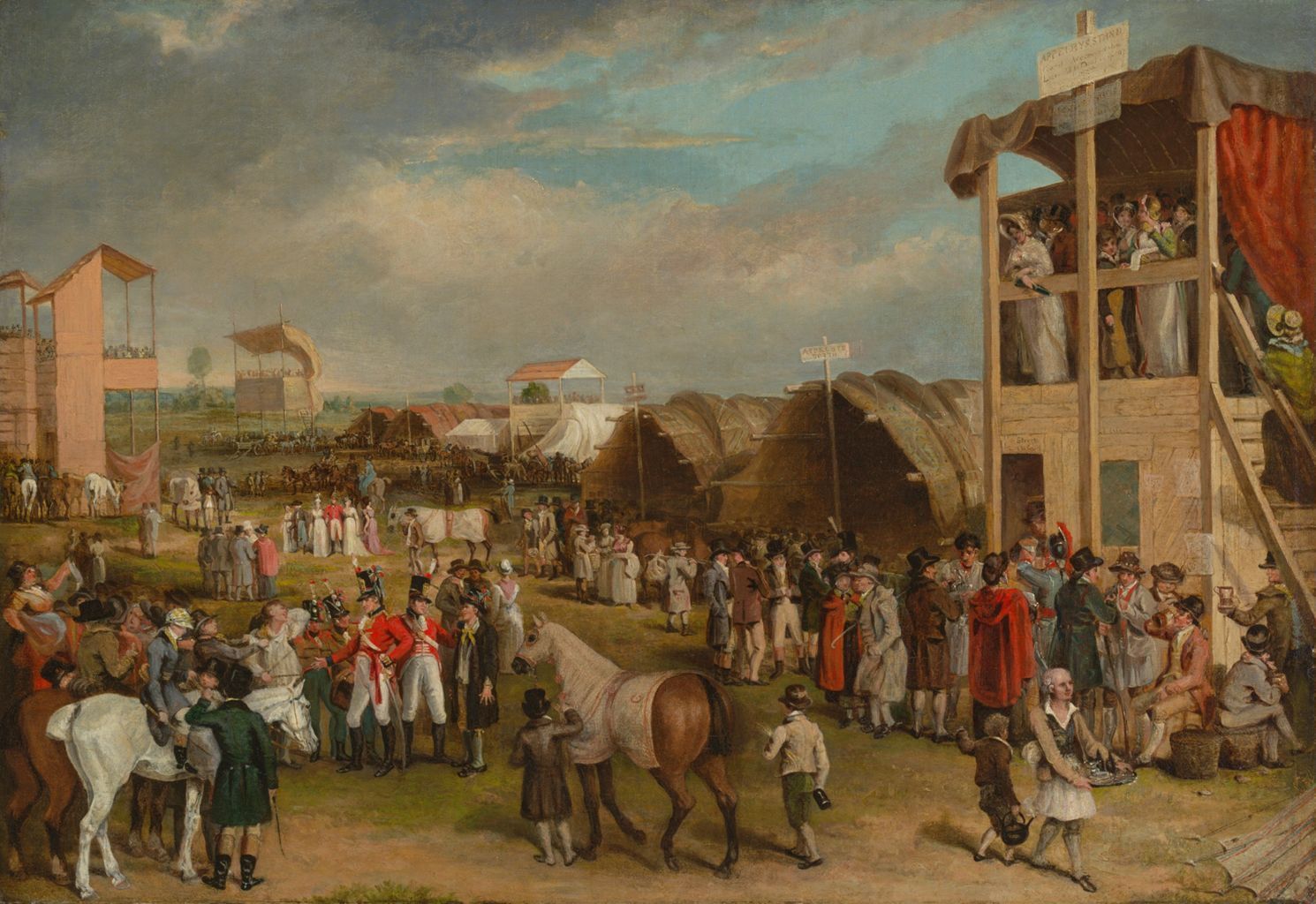
Oxford races at Port Meadow in c.1820, by Charles Turner
This conjunction of the final hurrah of Oxfordshire horse-racing4 and Arthur’s presence in the city does not prove any causal link with his apparent inability to remain solvent throughout his life, but it may be one suggestion as to why he never completed his degree. Next we find him boarding – and presumably teaching – at the grammar school in Bideford in Devon.5 But he had little time to consolidate his financial position because in 1883 he went into business with no capital of his own; an uncle deposited two thousand pounds into a bank account for the project.6 Rushing into commerce appears to be a rash move, but Arthur’s hand may have been forced; the death of his father in the following year aged just 54 suggests that Mr Atkinson may have already been ill, obliging Arthur to step in as the family bread-winner rather sooner than he would have liked.7 Evidently Arthur received no inheritance from his father, either because there was nothing to be had, or because he could not be trusted with a lump sum.
However, as always Arthur was determined to live in the style to which he felt he was entitled, acquiring a home in the elegant Newcastle suburb of Gosforth, sometimes known as “Gosforth Garden Village”. He also aimed high with business premises in St Nicholas’s Buildings in Newcastle. And a year after his father died, he acquired a wife too, in the shape of Margaret Naomi Dickenson.8 Margaret’s father, a railway inspector, had left her an annuity when he died in 1872.9 Two children quickly appeared: Edith in 1886,10 and John in 1887.11 So, in the space of just four years, Arthur went into business, he acquired an expensive office in Newcastle, a smart villa in Gosforth, a wife, and two children. Then, a few weeks after the birth of his second child, his affairs were put into the hands of the receiver.12

St Nicholas’s Buildings: Arthur’s smart premises
It was established at the bankruptcy hearing that Arthur owed £16,272 0s 11d, and his assets amounted to £738 12s 2d, giving a deficit of £15,534 8s 9d.13 And at a subsequent hearing it was noted that the court intended to ascertain the source of this astonishing figure by examining “certain vague statements as to his betting and gambling”. Arthur provided an account from his betting agent in London, but afterwards admitted that it was not complete. As well as borrowing from his wife, he was in the habit of drawing cheques in the names of regular business contacts, but instead of paying the cheques to the relevant person, he cashed them and kept the proceeds for his personal use.14 He was even accused in 1889 of obtaining credit by false pretences from Fowler Brothers, but he was found not guilty and discharged.15
Exactly when Arthur’s wife Margaret died is unclear, but by 1895 he had found his way to Brighton where he remarried to Helen Ann Bumpus, a divorced lady who let rooms in Preston Street.16 Her large house at number 14 must have made her an attractive prospect to a man who, she later revealed, relied on small and irregular hand-outs from his family.18 At the time of his marriage he described himself as a “gentleman”, and Helen confirmed that he had no occupation all the time she knew him.17
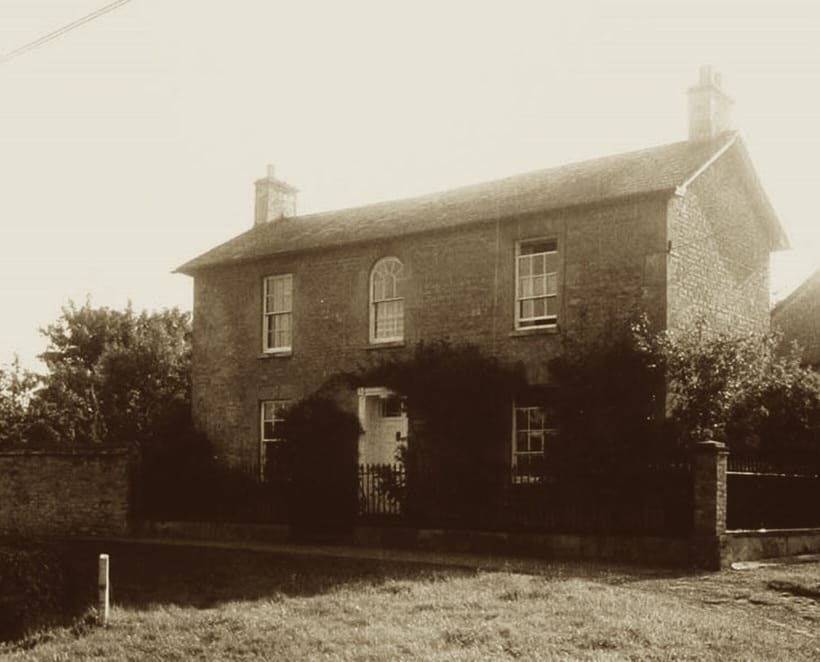
Prospect House in Weston on the Green
Why Arthur and Helen did not simply stay put and make the best of their circumstances in Brighton is a mystery. They moved about “from place to place” before they fetched up at handsome Prospect House in Weston on the Green in the autumn of 1898.19 Perhaps being in Oxfordshire again reminded Arthur of his happy-go-lucky days as a student. It is typical of him to choose an unnecessarily grand stone house with four bedrooms, cellars, a kitchen with separate larder, and detached outbuildings with rooms above.20 Where did he think he was going to acquire the £19 per annum to pay the rent? From his wife and family, presumably. Arthur earned small change by pottering about keeping ducks and chickens, and he was a pleasant enough husband provided he had not been drinking. The problem was that usually he had been drinking. “If he had money he would spend it in drink and betting,” revealed Helen, “and that is how the quarrels arose.” Realising that she could stand it no more, she retreated to the house of her friend Mrs Franklin. In the week before his death, Arthur had sold all the poultry to Thomas Kirtland at the Chequers, so Helen called at Prospect House to ask for some money to pay Mrs Franklin for her keep. Arthur’s adolescent son John was staying with his father at the time, and he told Helen he was not allowed to let her in. His father was in the Ben Jonson.
On Saturday Helen scrambled up a ladder and over the back wall to gain entry to Prospect House through the back door. She wrote a letter to Arthur and left it on the dining room table: “I have been round to bring some food for the cats, at the same time to ask you to let me have a shilling or two as you know I have none. Please send it to me [at] Mrs Franklin’s, as I must pay for some food… From your Wife.”21
On the morning of Monday 28 May, Arthur called at the home of farm labourer Thomas Constable in North Lane and asked to borrow a shilling so that he could go to Oxford. Constable did not see Arthur alive again. When Arthur returned in the evening, he spotted labourer Henry Brain and called him inside. He told Brain that he was tired, having walked all the way to Oxford and back, perhaps wishing to save his shilling for betting, or to give to Helen. He said he would like a drink but had none in the house.
On Tuesday afternoon, Helen asked Henry Brain to help her find her husband. Brain went into the house and called out, but received no answer. Upon searching the rooms, he found Arthur undressed and lying in his bed. He was dead. On the washstand by the bed stood a small poison bottle, a wine glass and a bottle of water. There were three letters and a tobacco pouch containing a shilling; one of the letters was the one Helen had left in the house on Saturday, one was addressed to Arthur’s mother “which was of extraordinary character, and in which there was a reference to betting”, said the coroner.22 The third letter was addressed to Thomas Constable.
It said: “Dear Tommy, in my chest my twelve months’ pay you’ll find. Likewise (I was going to say) a lock of my hair, but I fear that it is growing too thin and grey to furnish the aforesaid lock. So take the chest and leave the lock.” He explained that he had walked to Oxford and back, and upon his return he found that his wife and Mrs Frankln had been in the house “after some more of their stealing tricks”.23 He revealed that a week before he had bet the women a sovereign that he would do away with himself, and sneered that now they had what they wanted. His letter exhibited considerable hostility towards Mrs Franklin, and pleaded particularly that she not be allowed to touch his body. Along with the letter, Arthur made a point of returning the shilling to Thomas.
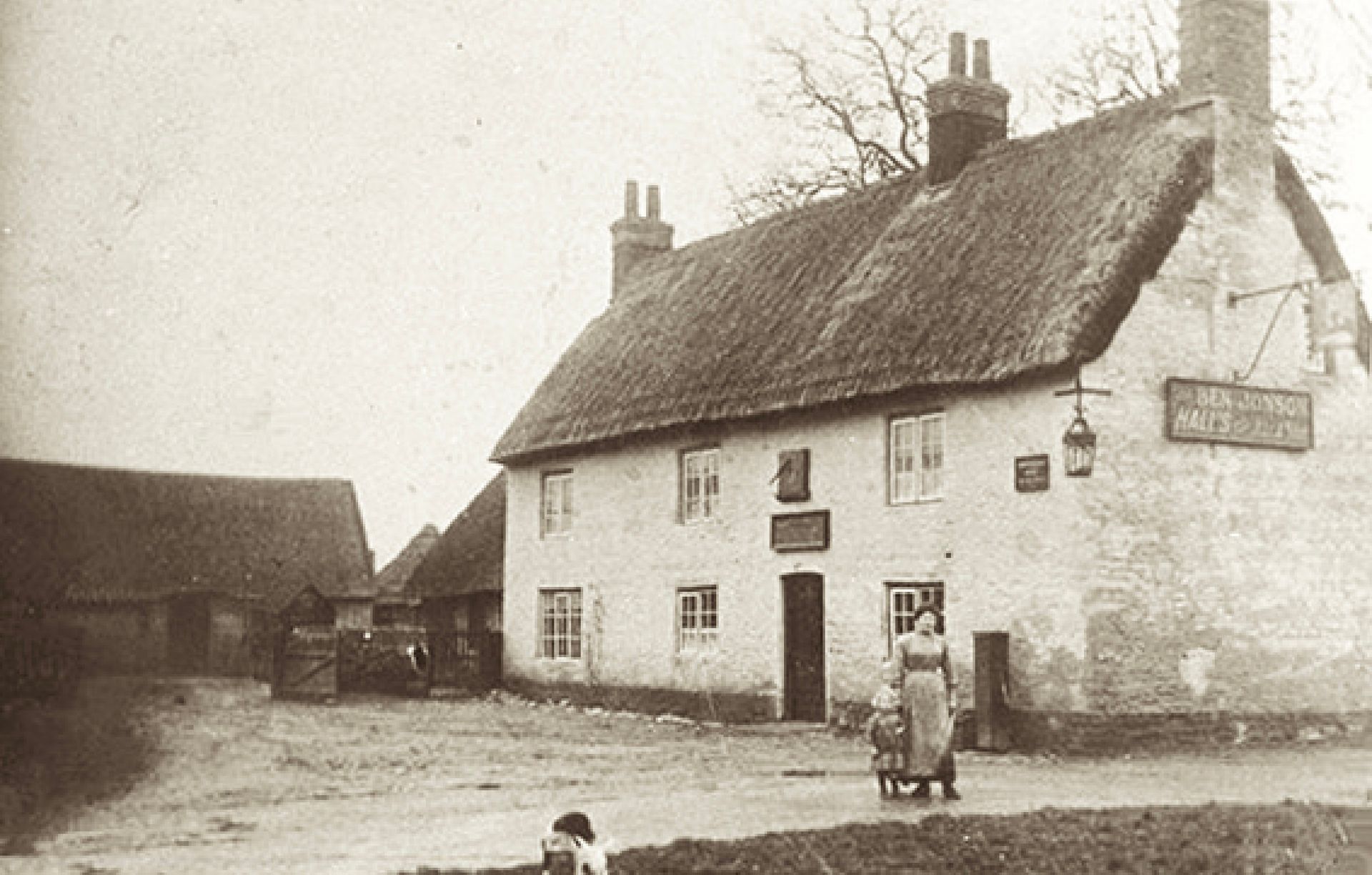
The Ben Jonson at Weston on the Green
With the dreaded word “suicide” hanging in the air, the coroner at the inquest in the Ben Jonson became anxious to establish the less problematic verdict of insanity. Until 1882 suicide had been considered a mortal sin and was theoretically punished by a burial after dark and away from hallowed ground. Suicide itself was decriminalised only in 1962.24 Before that, it was easier for all to agree that, yes, the person destroyed themselves, but only because they were out of their mind at the time. The coroner produced three sketches by Arthur showing the figure of a man hanging from a gallows, and announced meaningfully: “These papers are very extraordinary.” He enquired of Helen whether there was any insanity in the family. (The belief still lingered that mental illness could be heritable.) Helen confirmed that her husband’s cousin was indeed deranged and had a “keeper” with him. This job-title carried thrilling hints of the lion-tamer, and the jury took their cue, returning a verdict of “suicide while of unsound mind”.25 Arthur was duly buried at St Mary’s, Weston on the Green. His children went to live with his mother in Dorset.
It would take a braver historian than this author to attempt a diagnosis of Arthur Atkinson’s troubles or to allot blame in these unhappy lives. Technological advances like the telegraph raced along at their own merciless pace, whilst people remained as muddled and imperfect as ever.
Julie Ann Godson’s Oxfordshire history books are available from Amazon.
1 1861 England Census, Gateshead South
2 Oxford University Alumni, 1500-1886, Henry Arthur Cameron Atkinson, Gateshead
3 “Port Meadow Races”, E. H. Cordeaux and D. H. Meadow, Oxoniensia, volume XIII (1948)
4 Oxford Times, 8 October 1910
5 1881 England Census, Bideford
6 Newcastle Evening Chronicle, 15 December 1887
7 England & Wales, Civil Registration Death Index, 1837-1915, Tynemouth, Northumblerand, Mar 1884, Thomas Atkinson aged 54
8 Evening Standard, 17 February 1885
9 https://www.findagrave.com/memorial/212831757/john-dickinson, 29 June 1872, John Dickinson
10 England & Wales, Civil Registration Birth Index, 1837-1915, vol 10b, page 293, Castle Ward, Northumberland, Jul-Aug-Sep 1886, Edith Naomi Atkinson
11 England & Wales, Civil Registration Birth Index, 1837-1915, vol 10b, page 285, Castle Ward, Northumberland, Oct-Nov-Dec 1887, Arthur Fewster Atkinson
12 Bristol Mercury, 30 November 1887
13 Bristol Mercury, 30 November 1887
14 Newcastle Evening Chronicle, 16 November 1888
15 England & Wales, Criminal Registers, 1791-1892, 14 Feb 1889
16 East Sussex Record Office; Brighton, England; Sussex Parish Registers; Reference: PAR 277/1/3/1, Brighton St Peter, 12 Jan 1895
17 Oxford Review, 2 Jun 1900
18 Oxford Review, 2 Jun 1900
19 Oxford Review, 2 Jun 1900
20 Banbury Guardian, 23 August 1900
21 Oxford Review, 2 Jun 1900
22 Oxford Review, 2 Jun 1900
23 Oxford Review, 2 Jun 1900
24 In 1918 Helen’s first husband, John Myzoule, was prosecuted for attempted suicide and imprisoned for one day. National Archives; Kew, London, England; HO 140 Home Office: Calendar of Prisoners; Reference: HO 140/343, Chelmsford, Essex, 16 Oct 1918, John Alexis Myzoule
25 Oxford Review, 2 Jun 1900