- Forgotten Lives of Oxfordshire
- Posts
- The squire, the cook, their daughter, and the Duke: part 2
The squire, the cook, their daughter, and the Duke: part 2
The Cook's Daughter's Tale
In part 1 we examined the scandalous marriage between the parents of Sophia Wykham, proprietress of Thame Park. As a young man of 19, William Wykham of Swalcliffe Park had determined upon marrying his tenants’ cook Elizabeth Marsh, a woman of 37. The marriage was tragically short because Elizabeth died just after giving birth to Sophia’s younger brother in 1790. The little boy died aged 7, and then a few weeks after inheriting Thame Park, Sophia’s father died too. Sophia Wykham would become one of the richest heiresses in the land, so what kind of choice of a husband would she make? Would the rule-breaking nature of her parents’ marriage affect high society’s attitudes towards her? Would she feel as free from convention in her choice as did her parents? This feature is based on an article which first appeared in the Oxfordshire Local History Journal.1

Thame Park
WHETHER OR NOT the ten year-old orphan Sophia Wykham moved in to Thame Park immediately or remained at Swalcliffe, she will have been accompanied by guardians: her maternal grandfather William Marsh, her uncle Philip Wykham, and possibly her paternal aunt Mary (who had married Reverend Willoughby Bertie, brother of Lord Abingdon). Swalcliffe was advertised for let once more.2 Sophia's other guardians were Banbury lawyers William Walford and James Wake Golby.3
Although Sophia's grandmother was entitled on her death to dispose of the Wenman estate, as a female she was not in a position to pass on the Wenman title, which now became extinct. And William Richard's brother, Philip Thomas Wykham, felt that his mother's right to dispose of the Thame Park property in such a way was also worth challenging, so a bafflingly complicated suit was heard in 1811.4 Throughout Sophia's proprietorship at Thame Park, Philip had continued to describe himself as being "of Thame Park", and one cannot but help speculate on the atmosphere within the household during the drawn-out case in Chancery. The result went against uncle Philip, and after 1811 he lived at nearby Tythrop House. By 1817, Sophia was twenty-seven years old and less in need of a chaperone, and Aunt Mary and Rev Bertie lived in Grosvenor Square in London.5 What kind of suitor would she attract?

Princess Charlotte: detail from the portrait by George Dawe, painted in 1817,
the year of her death. [Photograph: National Portrait Gallery]
In 1817 disaster fell upon the royal family, and on the nation too. The much-loved Princess Charlotte, only heir of the Prince Regent, died giving birth to a stillborn baby boy. The nation was convulsed with grief; after the profligacy and immorality of the Hanoverians, Charlotte had embodied the people's hopes for a fresh start.
In typically vulgar style, the Prince Regent's ghastly brothers abandoned their mistresses and plunged into an unseemly race to the altar in hopes of making themselves the father of the next monarch. The Duke of Clarence had been living with an actress called Dorothea Jordan who had given him ten illegitimate children. No matter. At the death of Princess Charlotte, the Duke began to pursue eligible women in and around the royal courts. Traditionally, even up to World War I, princely marriages were expected to involve a member of a foreign dynasty in order to reinforce the national interest. But this was an emergency.

The Duke of Clarence in dress uniform, by Martin Archer Shee, c. 1800
As one of the richest heiresses in the country, they didn't come much more eligible than Sophia Wykham of Thame Park. And, for the same reason, only the most exalted suitor might be expected to gain a hearing at Thame Park in spite of Sophia's colourful maternal background. A possible future king might be forgiven for imagining his chances of success were good. Sophia seems to have been a particular favourite, and Clarence visited Thame Park more than once to urge upon her the opportunity of being the mother of the next monarch. A close examination of the original sources reveals the precise chronology – and rapidity – with which the courtship gathered steam, and then collapsed. The diary of Mrs Francis Calvert suggests in her entry for 8 February 1818 that Sophia had accepted the Duke's proposal, and four days later Sophia threw a party for one hundred guests at Brighton with the Duke as guest of honour.6
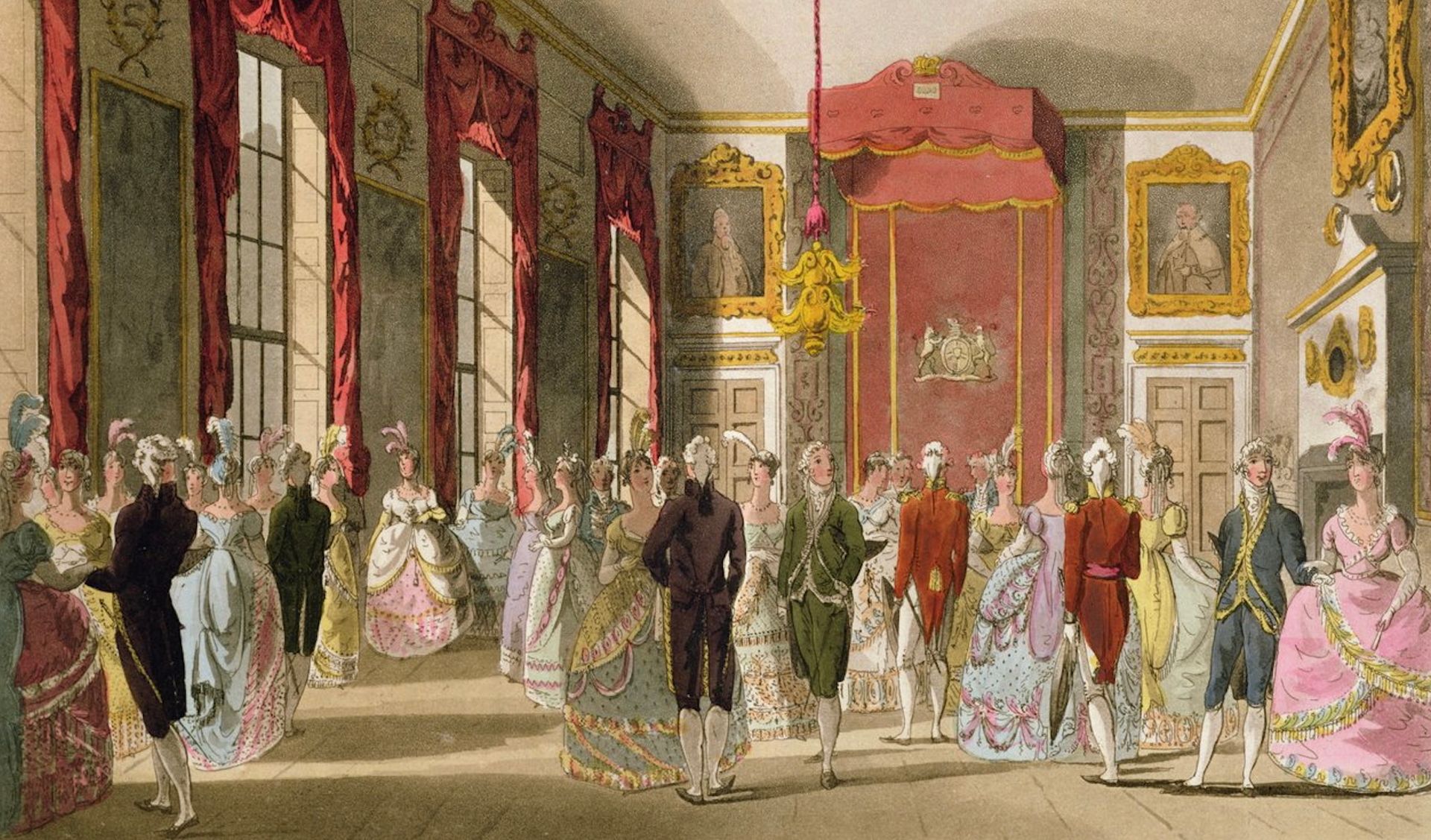
Sophia’s engagement seemed to be confirmed by her party in Brighton in 1818
The Duke spent Sunday 1 March with Sophia at Thame Park.7 Back in town on the Monday, the Duke told the diarist Charles Greville that Miss Wykham and he would marry only when they could do so legally, and with the consent of Parliament, before whom he meant to bring the matter. It seems reasonable to suppose that this was the stance the couple had decided upon during the Duke's visit to Thame Park the day before. By notable coincidence, that same morning – so presumably submitted for typesetting on the Sunday – a warm description of Miss Wykham's virtues appeared in the press: "She is mistress of the most refined accomplishments, and possesses the sweetest temper, united with the most elegant manners… From the Duke's domestic habits, and the goodness of his disposition, his union with a Lady so highly gifted, promises not only happiness to themselves but satisfaction to the country."8
Mrs Calvert would appear to have seen the article by the time she wrote her outraged diary entry for 3 March. "There is a fine, flaming paragraph in the British Press, puffing her in a most absurd way. It will be very disgraceful to permit him to marry her," she announced, and then spat, "Her mother was a kitchen maid." Uncomplicated class snobbery was the basis of Mrs Calvert's objection, an attitude likely shared by the wags who had by now dubbed Sophia "High Wickham" (sic).9 An obscure young squire's indiscretion in marrying his tenants' cook might be accommodated but, for some, marrying that cook's daughter to a prince of the blood was taking accommodation too far.
Press certainty began to wobble. On 5 March 1818 a syndicated report suggested that intermarriage with a British subject, rather than a foreigner, was the factor rendering the union unlikely, rather than an unsuitable family background.10 Evidently the consent of Parliament was not forthcoming because the marriage had definitely fallen through by 6 March. "The Match is certainly quite off," notes Mrs Calvert on 6 March. "Neither the Regent nor Ministers would hear of it."11 Claims circulated that Sophia had turned down the fifty-two year-old Duke rather than the other way round, but these may have been put about by Clarence himself for reasons of gallantry. He was a generous and unstuffy old cove, and certainly he was no snob.12

Diarist Charles Greville described Sophia as a "a half-crazy woman of large fortune"
An old friend would eventually raise its head, as it is still prone to do even today in the case of an aristocratic female behaving otherwise than her male counterparts wish. When Sophia's Englishness might easily have been invoked by objectors, it was actually hints about her sanity that were used after the event to justify her exclusion as a potential royal bride. Diarist Charles Greville later described Sophia without explanation as "a half-crazy woman of large fortune".13 He went on: "George IV14 , I believe, put a spoke in that wheel, fortunately for the Duke as well as for the country." But no evidence of how this craziness manifested itself was offered.
Whether or not Sophia was willing to commit the faux-pas of marrying a royal duke whilst remaining brazenly English, Clarence eventually opted for the traditional European princess. Quite possibly out of sheer laziness, in July 1818 he married German princess Adelaide of Saxe-Meiningen to absolutely no dynastic effect; all of the couple's five babies were either born dead or died as infants.
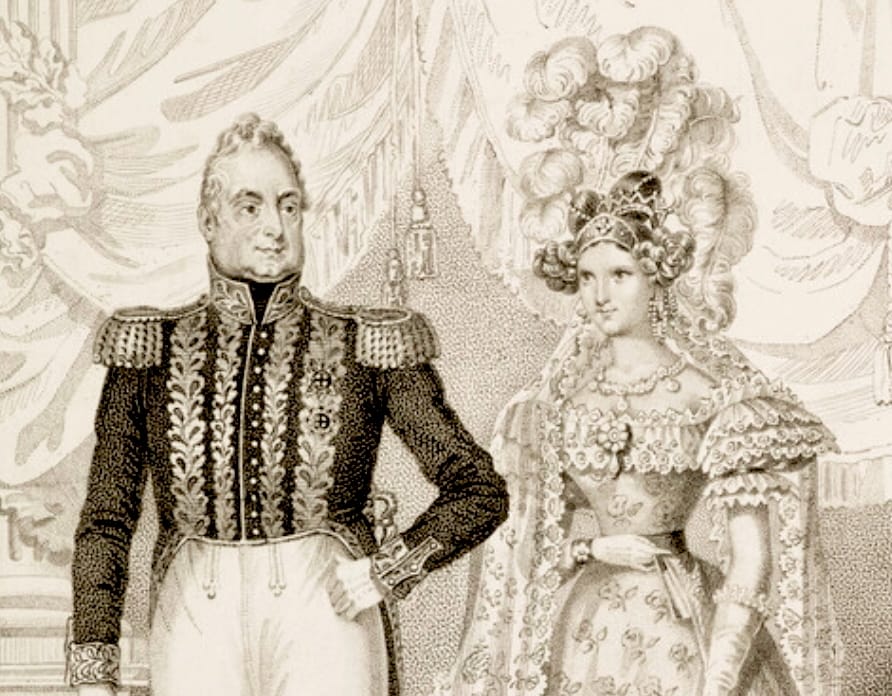
Clarence with his eventual bride, Princess Adelaide of Saxe-Meiningen
After Clarence eventually succeeded as William IV, he ironed out the anomaly in Sophia's social rank by granting her a peerage. On 17 May 1834, she was created Baroness Wenman of Thame Park and Swalcliffe in the County of Oxford.15 Again, Greville weighed in: "The maddest thing of all appeared in the Gazette of Tuesday – the peerage confirmed on [Sophia Wykham]. She is a disreputable half-mad woman! He perhaps thought it fair to give her compensation for not being Queen, for he wanted to marry her, and would have done so if the king [George III] would have consented."
Were Sophia Wykham's decisions really influenced by this kind of recreational sniping in society about her antecedents? On the face of it, she would not seem to be a woman so easily swayed. Her personal reaction to her Nemesis George IV ascending the throne in 1821 suggests that she bore no grudge; she staged a huge celebratory jamboree at Thame Park. On 29 August 1821 three hundred nobility and gentry dined within the brilliantly-lit great house, plus twice as many tenants. Outside in a marquee a further thousand guests were fed. Firework artists imported from London furnished a spectacular display and seven bands provided the musical accompaniment.16

Handsome Lord Cranborne tried and failed to win Sophia’s hand
Sophia never did marry, in spite of other handsome offers. "All the men are after her," Mrs Calvert had reported three years earlier after Sophia turned down the handsome Lord Cranborne.17 In an era when upper-class marriage was a clan decision, not a personal one, family pressure was not a factor for Sophia; her parents and brother died when she was still a child. It seems reasonable to suppose that her grandfather, William Marsh, a man who had a daughter in 1751, was dead by the time Sophia reached marriageable age in 1811. Her guardians, uncle Philip Wykham and aunt Mary Bertie, had moved out.
We are not aware of the circumstances surrounding Elizabeth Marsh's death, which appears to be consequent upon the birth of Sophia's brother William. Was it so agonisingly protracted that it left Sophia traumatised? Many, many élite young women will have witnessed the perils of child-birth, and yet they still went on to marry and risk having a family. For most, it was the only way to leave home and acquire an establishment of their own. An unmarried female had little status in society, but a married woman commanded respect. As a financially-secure proprietor of her own immense estate Sophia Wykham had no need to leave her childhood home or marry in order to acquire social status. The assumption that any woman must want children is too sweeping, and anyway plenty of married couples fail to produce children. The assumption that most women might not want to share a bed with the unappetising Duke of Clarence would probably enjoy more support.
Was a preference for her own sex what rendered Sophia "mad", "crazy" and "disreputable" in the eyes of the élite males of Regency England? Like her contemporary the diarist Anne Lister (1791–1840), a comfortably-off Yorkshire landowner, Sophia was not obliged to marry for the sake of financial stability; she was free to live as she pleased – up to a point. Lister conducted multiple same-sex liaisons but still felt sufficiently guarded about her personal life to write her diaries in code. (They were finally transcribed and published in 1992.18 ) Evidently it was a lifestyle not to be paraded in public, but in a world of arranged marriages, the sexual preferences of the parties came very low on the list of priorities. (Two of Anne Lister's lovers – Mariana Belcombe and Maria Barlow – are known to have been married.) They would be expected simply to shut their eyes and think of England until their duty to provide an heir was done. After that, discretion was the watchword, not abstinence. Were insinuations about Sophia's mental stability therefore simply a manifestation of the time-honoured method by which the reputations of aristocratic women have so often in history been undermined?
Sophia herself may or may not have desired a match with Clarence; her failure to marry elsewhere remains open to interpretation. Perhaps the Duke was the one true love of her life and she never countenanced any other man, perhaps she was not interested in men, or perhaps she was quite fulfilled in her life as the proprietor of enormous landholdings. But the private diaries of the time agree that, while Clarence was sufficiently keen on her to press his suit more than once, evidently to his brother the Prince Regent it was unthinkable that the queen of England should be the daughter of a cook, a circumstance which might have perpetuated for another generation the ridicule in which the Hanoverians were already held by their subjects – largely as a result of the Regent's own conduct.
The reaction of society to the same boundary-crossing union is expressed in terms of mild concern on the part of Mrs Wrightson for her cook Elizabeth Marsh in March 1789, which then intensifies into utter contempt from Mrs Calvert for that same woman in February 1818 ("a kitchen-maid"). If Sophia Wykham's unusual choice not to marry, not even to the Duke of Clarence (and one speculates that she may have been able to pull even that one off had she really put her back into it), was the result of a fear of an early death in childbirth, her attainment of the age of eighty probably felt like a justification. Her mother Elizabeth Marsh followed her heart in marriage, and little joy it brought her. Elizabeth's daughter Sophia Wykham enjoyed a life free of male governance, which may have been what she wanted all along, and she outlived her critics too.
1 Oxfordshire Local History Journal, volume 11, pp 27–37
2 Jackson's Oxford Journal, 30 August 1800.
3 'William Richard Wykham Esq', England & Wales, Prerogative Court of Canterbury Wills, 1384-1858, PROB11/1347.
4 Vesey, F., Reports of Cases Argued and Determined in the High Court of Chancery, volume 18, 1855, pp 395–423.
5 UK, Poll Books and Electoral Registers, 1538-1893 for Willoughby Bertie, 1818.
6 Oxford University and City Herald, 14 February 1818.
7 Perthshire Courier, 19 March 1818.
8 Globe, 2 March 1818.
9 World and Fashionable Sunday Chronicle, 9 March 1818.
10 Bath Chronicle and Weekly Gazette , 5 March 1818.
11 Blake, Mrs A E K, ed., An Irish beauty of the Regency (1911) pp 311–313.
12 His closest companion was Lord Ashbrook, son of an Oxfordshire innkeeper's daughter. See the author's book The Water Gypsy: how a Thames Fishergirl became a Viscountess (2016).
13 Greville, Charles C F, The Greville Memoirs: A Journal of the Reign of Queen Victoria from 1837 to 1852 (Volume 2 of 3), diary entry for 25 June 1837.
14 Known at the time as the Prince Regent.
15 London Gazette, 20 May 1834.
16 Globe, 27 August 1821.
17 Blake, Mrs A E K, ed., An Irish beauty of the Regency (1911) p 21. James Brownlow William Gascoyne-Cecil, 2nd Marquess of Salisbury, KG, PC (1791–1868), styled Viscount Cranborne until 1823, was a British Conservative politician. He held office under the Earl of Derby as Lord Privy Seal in 1852 and Lord President of the Council between 1858 and 1859.
18 Lister, Anne, and Whitbread, Helena (ed.), I Know My Own Heart: The Diaries of Anne Lister, 1791–1840 (1992)