- Forgotten Lives of Oxfordshire
- Posts
- The history of Harper's weir
The history of Harper's weir
by Julie Ann Godson

Harper’s weir in 1811 and now
IN 1767 THERE WAS a ferry across the Thames at Clark's or Harper's weir, where a foot crossing existed possibly from the Middle Ages. In February 1868 one M Harper reported the weir bridge much broken, and as it formed part of a footway to several towns there was much local complaint.
I believe the engraving shows what was then known as "Harper's House" at Radcot weir in 1811. The name of Harper's was attached to this station in official records in November 1866. In March 1867 a Stroud builder inquired if Harper's weir was likely to be repaired within a fortnight, as he desired to barge down timber and stone for Hinton church. The Conservancy offered no immediate prospect of its rehabilitation. However, the weir piles were removed in 1868 and in October 1869, the Thames Conservators announced in the Oxford Journal that: “The weir between Radcot and Hart’s weir, also Harper’s, Watt’s or Old Man’s, and Tadpole, are already taken out… while the river itself will be in some places deepened, so that all obstructions to the rapid flow of the water will be in this district removed.” When even the Thames Conservators felt it necessary to give three alternatives for the name of this spot, it is unsurprising that the title of Harper's weir survived till at least 1884.
In 1892 a cut was dug across a bend in the river just upstream from an old weir and flash lock at Old Man’s Bridge, and the old weir was replaced by the present lock and moved to the other (northern) side of the island. The lock and new weir were opened in December 1892, and John Williams was appointed first keeper in February 1893. His body was recovered from the River after some floods during the same winter, and Alfred John Beesley came down from St John's lock. Beesley’s life was a tragedy of waterside history. He lost two young boys by drowning while at Lechlade; and one stormy night in the summer of 1912 his wife also drowned.
The old weir-keeper’s house began to suffer from subsidence, so at the time of the modern photo (1986), a new bungalow was being built behind the office hut. Construction materials can be seen stacked in the background.
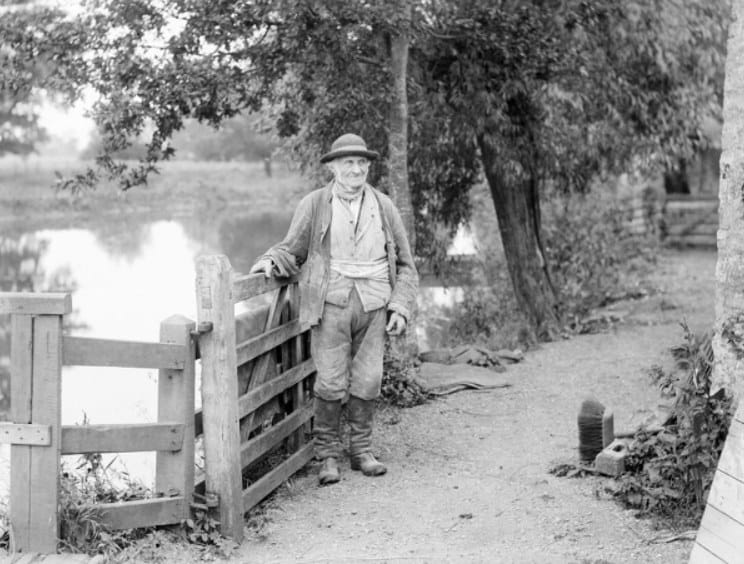
Harper, the weir keeper and fisherman on the River Thames at Radcot
[Photograph by Henry Taunt: Historic England Archive]
Thames Highway, Locks & Weirs, by Fred Thacker, 1920, is the first stop for historians researching the history of the river. However, the sources drawn upon are sometimes confusing and contradictory so, while you are most welcome to offer corrections, please first check the excellent “Where Thames Smooth Waters Glide” at https://thames.me.uk/index.htm