- Forgotten Lives of Oxfordshire
- Posts
- The body on the common
The body on the common
by Julie Ann Godson
Dying alone outdoors on a winter’s night is a desperately sad end for anyone. In November 1771 a young man who needed warmth and care became little more than an administrative problem for the South Leigh authorities to tidy away. It is now too late for us to do anything for him, except to remember him and his contribution to his country. And by following a logical trail of clues it is possible to recreate a surprisingly full picture of a long-forgotten life.
AT AROUND NINE O’CLOCK on Tuesday morning, 12 November 1771, a dead body was found on South Leigh Common near Witney. It was assumed that the young man had “lost himself” and wandered about all night, eventually freezing to death.1 Online weather records do not indicate particularly low night-time temperatures that month, so perhaps the man was already ill. What was he doing roaming the villages outside Witney, alone and on foot?
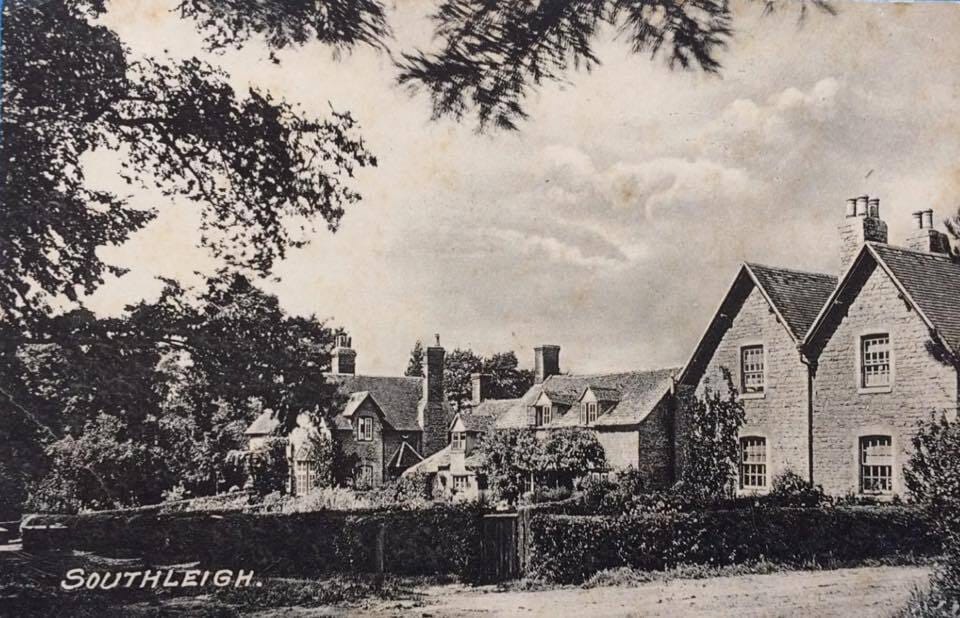
The doors of South Leigh remained shut in November 1771
It was not unusual at the time for those on the road to seek shelter for the night. Many more homes included barns, stables and out-buildings where those who could not afford an inn were allowed to bed down till morning. But the man was refused. Presumably he carried some form of identification because the Oxford Journal names him as Samuel Dark, a respectable out-pensioner (living out in the community) of Chelsea Hospital. Even so, nobody helped. However, equipped with this information we can trace his army pension papers and find out that he was a weaver by trade, born in Painswick around 1738.2 The Painswick church register shows that he was actually baptised in October 1736 and was the son of weaver Samuel Dark and grandson of weaver Emmanuel Dark.7
There was a great expansion in the export of cloth during the eighteenth century, but also periods of depression in the 1720s, 30s, and 40s. In Painswick clothiers experienced not just a fall-off in prices, but also the theft or deliberate destruction of cloth drying on tenters in the rack fields, presumably to limit the supply and firm up the prices for other producers. Is this what happened to the Darks? A lucky find in an academic article on the cloth trade in Painswick may give us our explanation as to why Samuel junior abandoned the trade and joined up.
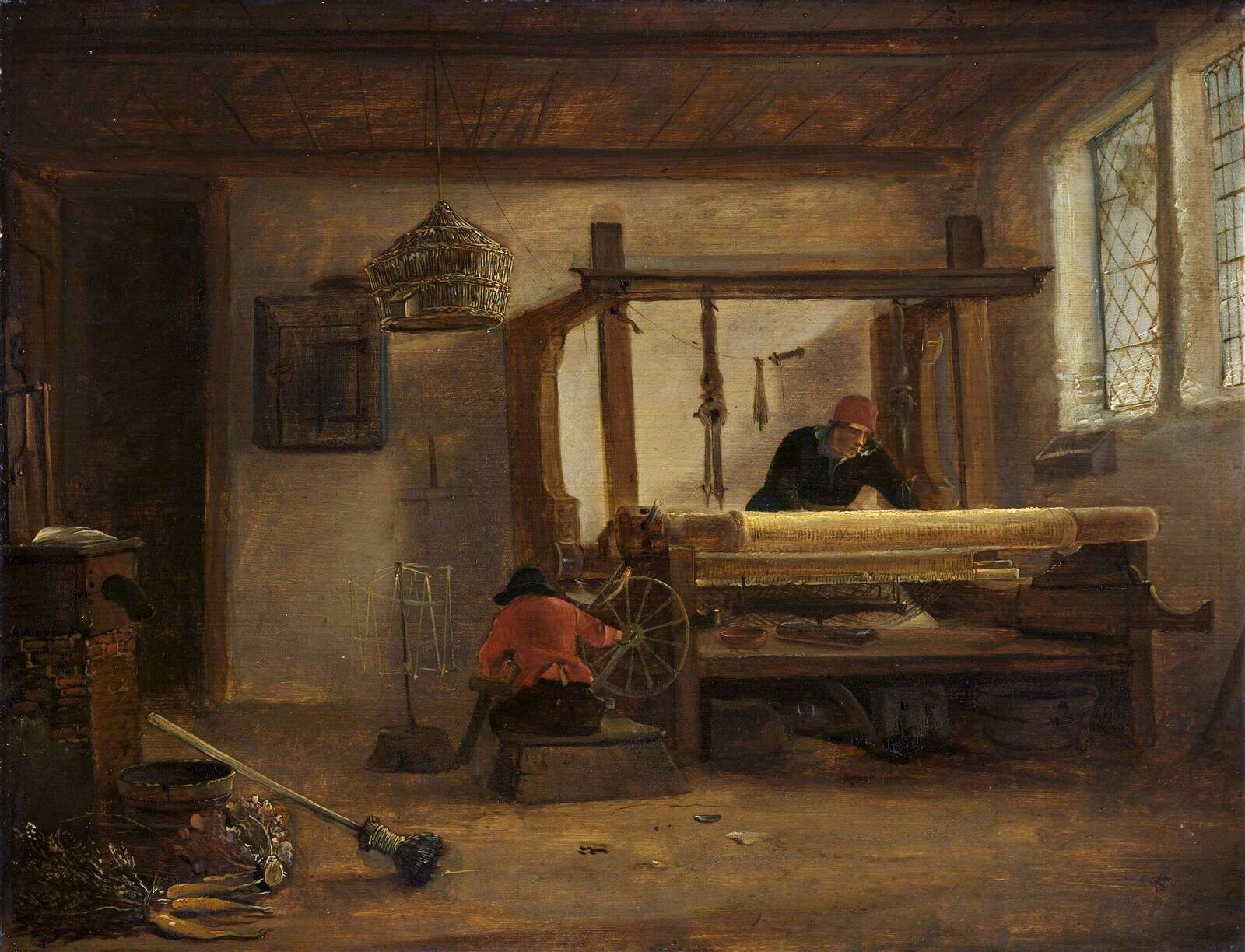
Weavers like the Dark family worked on looms at home
Gloucestershire historian Colleen Haine’s comparison of the wills of the weavers of Painswick over time shows a decline in wealth – finishing at the bottom of the list with Samuel Dark the elder.3 At the top of the scale, John Cardner, broadweaver, could afford to leave £10 to his wife in 1715, as well as a large quantity of household goods, and £20 each to a son and daughter. In the middle of the scale, in 1708 weaver John Cooke left a long list of household goods and broadlooms, altogether valued at just under £20. Four decades later, however, in 1757 the churchwardens offered for sale the entire goods of broadweaver Samuel Dark, our Samuel’s father, for just £5. They comprised a meagre:
2 beds with appurtenances
1 broadloom with all appurtenances
1 iron bolt
1 pail
2 half barrels
1 quarter barrel
1 long table
1 pewter plate
2 coffers
1 frying pan
1 pr of andirons
1 little brass kettle
3 chairs
1 skimmer with appurtenances
The fact that the churchwardens of Painswick were overseeing the sale suggests that Dark had done a runner, and perhaps left debts or even dependent family members chargeable to the parish.
The timing of Samuel the younger’s enlistment around the same time is suggestive. It looks as if catastrophic financial failure caused the break-up of the Dark family. Also describing himself as a weaver, Samuel joined the Second Regiment of Footguards (later the Coldstream Guards) in 1756.

British troops at the Battle of Vellinghausen in the Seven Years War
During the Seven Years War with France, the Second Battalion took part in two key engagements in Germany: the Battle of Vellinghausen in 1761, and the Battle of Wilhelmstahl in 1762. Samuel Dark would have been involved in heavy fighting at Wilhelmstahl, where the French forces were attacked from both front and rear and ultimately routed, effectively ending the war in Europe on 24 June 1762. The bravery of these men is largely forgotten by the general public today.
In October 1759, one Samuel Dark married Mary Rose at Dodington St Mary near Bristol.4 However, there was a large clan of Darks in the area, so we cannot be certain this is our Samuel. Also, Dodington is a full twenty-five miles south of Painswick, but of course Samuel may have been coming from his barracks elsewhere, not from Painswick. In October 1764 one Mary Dark of Tewkesbury died.5 Again, this may or may not not be our Samuel’s wife; Tewkesbury is more than forty miles north of Dodington and twenty miles north of Painswick so it is not a good match geographically. But the dates do dovetail neatly with our Samuel’s story. His army papers show that he claimed his Chelsea pension two years later in September 1766. They also reveal another telling detail: Samuel Dark had testicular cancer.
With no remaining ties in the West Country, was the former weaver making for Witney where the cloth trade was now recovering? If he was coming from the London direction, it looks as if he never reached Witney – or if he did, he was turned away. We will never know.
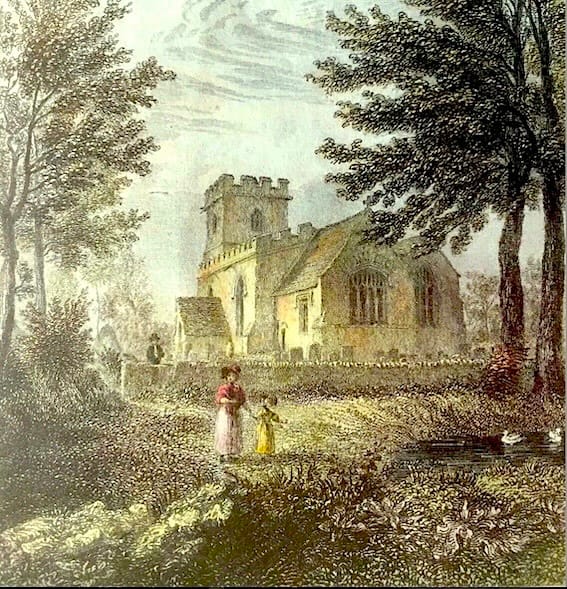
Did anybody ever visit Samuel’s grave at the Church of St James the Great in South Leigh?
Young Samuel Dark died alone on an open common in an unfamiliar village and was buried at the Church of St James, South Leigh on 22 November 1771, forever more a resident of Oxfordshire.6 He had done nothing wrong. His father had been overwhelmed by adverse market forces and fled so Samuel left too, to fight for the king. If Mary Dark of Tewkesbury was his wife, she had died. But in spite of mortal sickness, Samuel battled on, trying to find work. And then after his miserable death, in a final gesture of dismissal of his service to his country, he was described in the parish register as a “travellar” (sic), or gypsy.
Former servicemen and women falling on hard times once they step back into civilian life is a keynote of our times, but it is nothing new. Returning after many years with rusty and out of date work skills to an unfamiliar world has always been challenging. Loved ones may perhaps have fizzled away, and the concept of “home” has for many lost any meaning. But any of us lucky enough to visit the church of St James the Great in South Leigh today now knows enough to pause there for a short while and give a thought to Samuel Dark, remembered at last.
Residents of Oxfordshire with an Oxfordshire Libraries card can gain free access in the county’s libraries to Ancestry and Find My Past. Get a card online and get stuck in! [https://libcat.oxfordshire.gov.uk/web/arena/join] Find a name in an Oxfordshire newspaper story on Find My Past then, if your subject is a soldier, have a look in the brilliant military section, and for the most user-friendly parish records of births, marriages, and deaths (in my opinion), jump over to Ancestry where you will also find Chelsea Pensioner records. And do let us know how you get on in the Facebook Julie Ann Godson Group.
1 Oxford Journal, 23 November 1771
2 The National Archives of the UK; Kew, Surrey, England; Royal Hospital Chelsea Pensioner Registers & Service Records, 1760-1882; Class: WO 120; Piece: 3
3 “The cloth trade along the Painswick stream from 1700 to 1800”, Colleen Haine, Gloucestershire Historical Studies, volume 11, 1980, pages 22-31
4 Bristol, England, Church of England Marriages and Banns, 1754-1938, Dodington St Mary, 1 Oct 1759, Samuel Dark m. Mary Rose
5 Gloucestershire, England, Church of England Baptisms, Marriages and Burials, 1538-1813, Reference Number: P329/1/IN/1/7, 17 Oct 1764, bur Mary Dark
6 Oxfordshire, England, Church of England Baptism, Marriages, and Burials, 1538-1812, Reference Number: PAR245/1/R1/3, Church of St James the Great, South Leigh, 22 Nov 1771, bur Samuel Dark
7 Gloucestershire, England, Church of England Baptisms, Marriages and Burials, 1538-1813, Reference Number: Gdr/V1/180, Painswick, 17 Oct 1736