- Forgotten Lives of Oxfordshire
- Posts
- Stand and deliver!
Stand and deliver!
by Julie Ann Godson
When Parliament emerged as the winner of the English Civil War, many angry Royalist officers were left roaming a country awash with guns. Highway robbery offered easy-pickings for out-of-work soldiers accustomed to handling weapons and riding fast horses. The grudge they harboured against the regicides provided a kind of virtuous cloak for what was actually old-fashioned daylight robbery. And their self-image as Cavaliers prompted a good deal of exaggerated gallantry towards the ladies, as well as the occasional Robin Hood-style generosity towards the poor. It was all part of the show, and served to win the public’s sympathy, a useful asset when on the run.
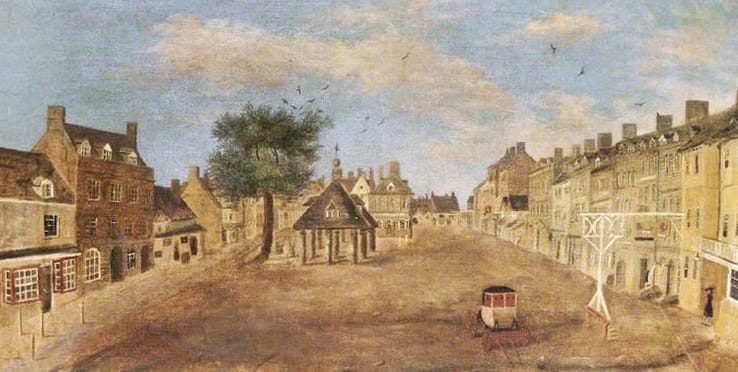
Chipping Norton before the new town hall [Credit: Chipping Norton Town Hall]
JAMES HIND was a Chipping Norton lad, baptised in July 1616.1 His father had been a god-fearing saddler and churchwarden2 of honest reputation who, recognising that his son was of above-average intelligence, scrimped and saved to send him to grammar school. When James was 15, his father purchased an apprenticeship with a local butcher.3 This arrangement was not to James’s liking and, having cadged some money from his mother, apparently he absconded. In some versions of his story it is at this point that James ran away to London to embark upon his career in highway robbery.4
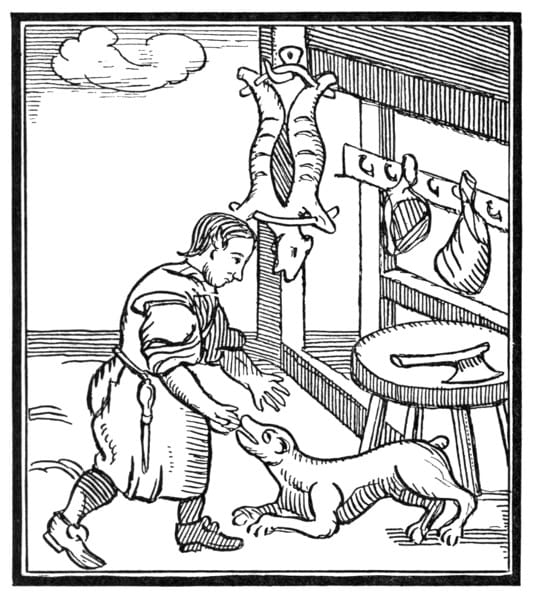
Hind was apprenticed to a butcher
A distinct lack of original sources leaves us with only the Chipping Norton parish registers with which to follow Hind’s actual movements. This means we can, as it were, overlay Hind family events on to national ones to try and sort fact from fiction during the war years. Certainly in 1638 James was back in Chipping Norton because he married local girl Margaret Rowland,5 and the couple had a daughter, Alice, born in 1640.6 The King raised his standard at Nottingham in 1642 indicating the commencement of the English Civil War, and Hind determined to fight for the Royalist cause. But the births of his children indicate that he was not away fighting constantly. In January 1644 King Charles summoned his first parliament in Oxford, and in November of the same year James and Margaret had a son, James.7 Another son, Samuel, was born in January 1646.8 The King was captured in 1647 and the Royalists rose again in May 1648. A son, pointedly named Charles, was born to the Hinds in 1648, but the date of his baptism is illegible in the register.9 It was some time after August, so it is tempting to assume that Hind was at home during the lapse in hostilities, and then left to resume fighting in May 1648, perhaps never to return.
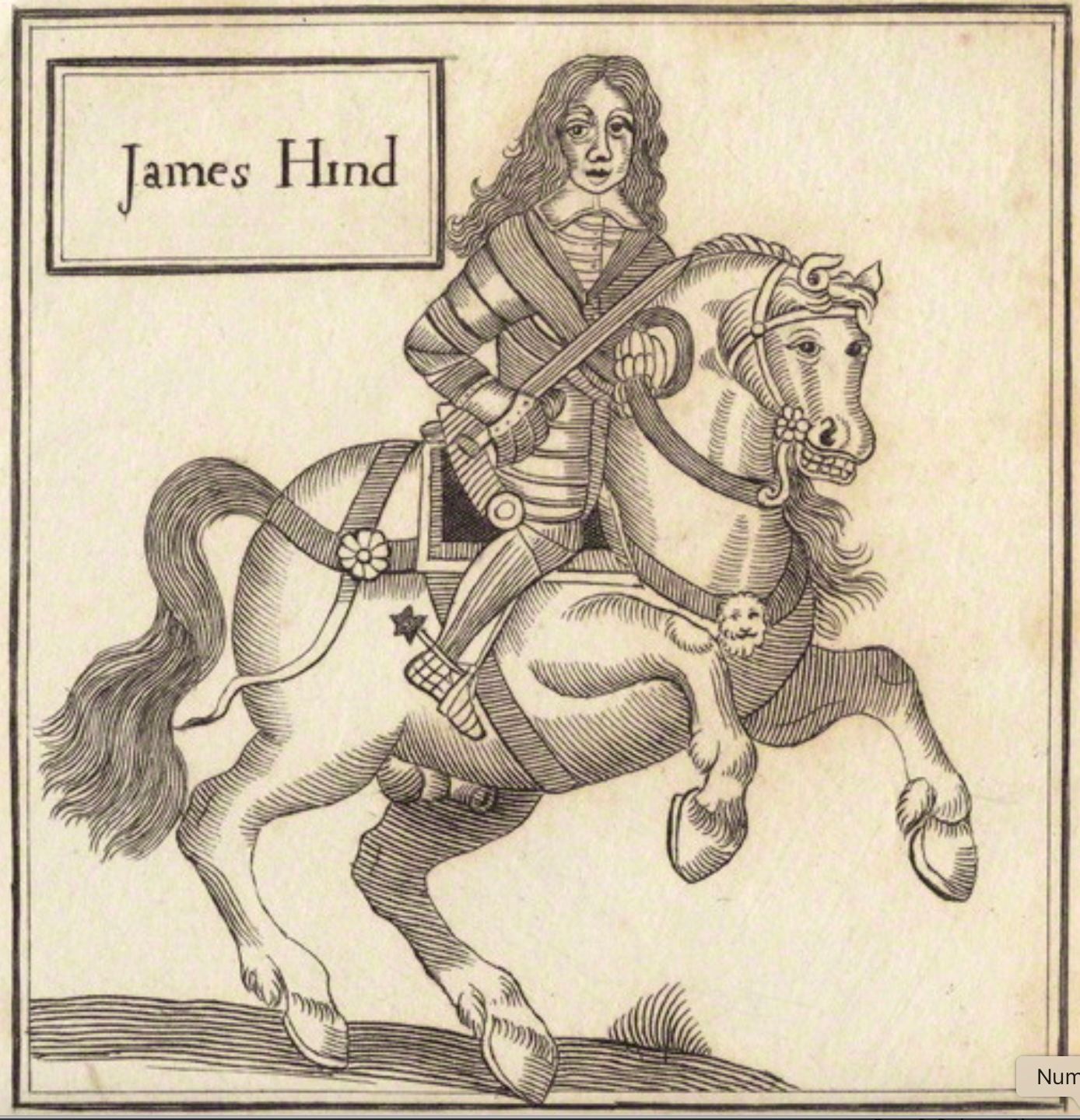
Hind depicted as a young Royalist officer on his cheerful steed
From this point onwards in Hind’s career, we rely on the various contemporary and near-contemporary pamphlets, broadsheets and chapbooks that recounted Captain Hind’s escapades. Naturally, the more sensational these were, the more copies they would sell, and the first publisher to market would sell most of all. The clumsiness of the typography suggests that some were rushed out while Hind was still alive – and even he described them as fiction.10 Years later, when he was eventually brought to justice, Hind would agree that many of the stories about him stretched the truth but, he insisted, “some merry Pranks and Revels I have plaid, that I deny not”. Even the publishers describe these accounts as “picturesque”.
Once confined to gaol and relying on admirers to send in luxuries like wine, the man himself was not above embellishing his history. Claims that he spent nine months in Ireland as a corporal in the Marquess of Ormonde’s Life Guard, then met the new king in Scotland and was promoted to captain, and finally took part in the Battle of Worcester in September 1651 are not credited to any documentary source and are impossible to verify (though this does not mean that they are untrue). The claim that Hind sailed to the Hague to collect supplies for the Royalists in May 1649 is perhaps reflected in a mysterious doodle in the Chipping Norton parish register. Once the reverse of the page carrying register entries for 1649 is turned upside-down, this otherwise baffling doodle clearly shows a ship with accompanying rowing boats, perhaps offloading supplies. Is it a coded boast in the church records of a staunchly Royalist parish that a local resident did indeed undertake a maritime adventure on behalf of the Royalist cause in 1649?
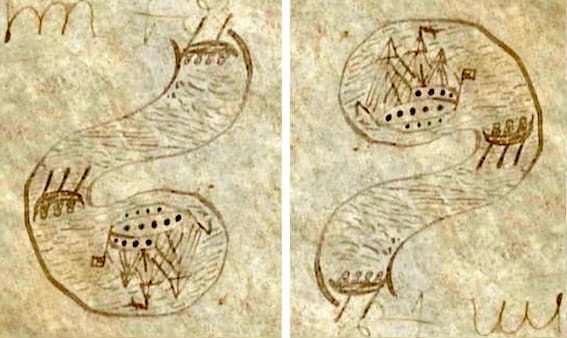
Left: A mysterious doodle in the Chipping Norton parish register. Right: Turn the page
upside down and hey-presto – a ship being unloaded by rowing boats
Indeed, many of the japes that follow should be treated with a pinch of salt, including how Hind entered upon the trade of highway robbery in the first place. One night in London, the legend goes, he was carousing in the company of a lady who had relieved a gentleman’s pocket of five guineas. When she was picked up by the constable and despatched to the lock-up, Hind was packed off with her for good measure. There he fell into the company of Thomas Allen, a notorious highwayman whose exploits were well known. Celebrating their release the following day, Hind and Allen became firm friends and Allen offered Hind a chance to become his partner in crime. But first he wished to assess young Hind’s potential.
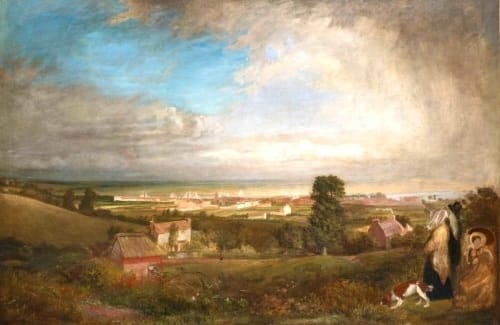
Shooter’s Hill: then a lonely spot in Kent
The location chosen for the test was Shooters’ Hill to the west of Blackheath – a much lonelier spot then than it is now. Soon a target appeared: a gentleman accompanied by his servant. Allen hung back to observe how Hind would deal with the situation. Clever Hind knew exactly what was expected of him. Approaching the coach cheerfully, he politely offered at gunpoint to relieve the terrified occupant of all his money. This produced a handsome haul of fifteen pounds. Conscious of his Cavalier obligations, Hind returned his victim twenty shillings so that he might complete his journey. Overcome with relief and gratitude (according to Hind) the gentleman swore he would never harm a hair on Hind’s head if the highwayman were ever in his power.
Allen was greatly pleased with the bravery and gallant conduct of his new comrade, and the two men swore to stand by one another to the death. Unfortunately for Allen, this oath of loyalty lasted only until 1649 when, shortly after the execution of King Charles I, a grand coach rumbled down the Great North Road towards London. No less than seven heavily-armed outriders signalled the importance of the personage within. He was the most powerful man in the land, Lieutenant General Oliver Cromwell. Considering the odds against them, our two bandits must be credited with considerable courage. Cromwell’s armed escort immediately set about them and Thomas Allen was captured and soon hanged. Captain Hind rode like the devil and escaped, killing his horse in the process – or so we are told. Unlike today, riding a horse to death was considered a sign of the horse’s loyalty and the rider’s proficiency, and was therefore a common trope in the myth-making of the time.
Hind had learned enough to maintain a solo career, racking up well-known regicide names among his victims, and furnishing pamphleteers with a handsome supply of colourful and probably apocryphal stories. One alleged victim was radical preacher and regicide Hugh Peters whom Hind encountered in Enfield Chase. No shrinking violet, Peters retaliated against the highwayman’s predictable demands by launching a scriptural debate with him. Perfectly well equipped by his fine education to bandy biblical quotes, Hind responded: "Pray, sir, make no reflections on my profession; for Solomon plainly says, 'Do not despise a thief'”. He pointed out that debate was useless anyway, because he was the one with a gun. The old Puritan found this difficult to deny, and handed over thirty pieces of gold.
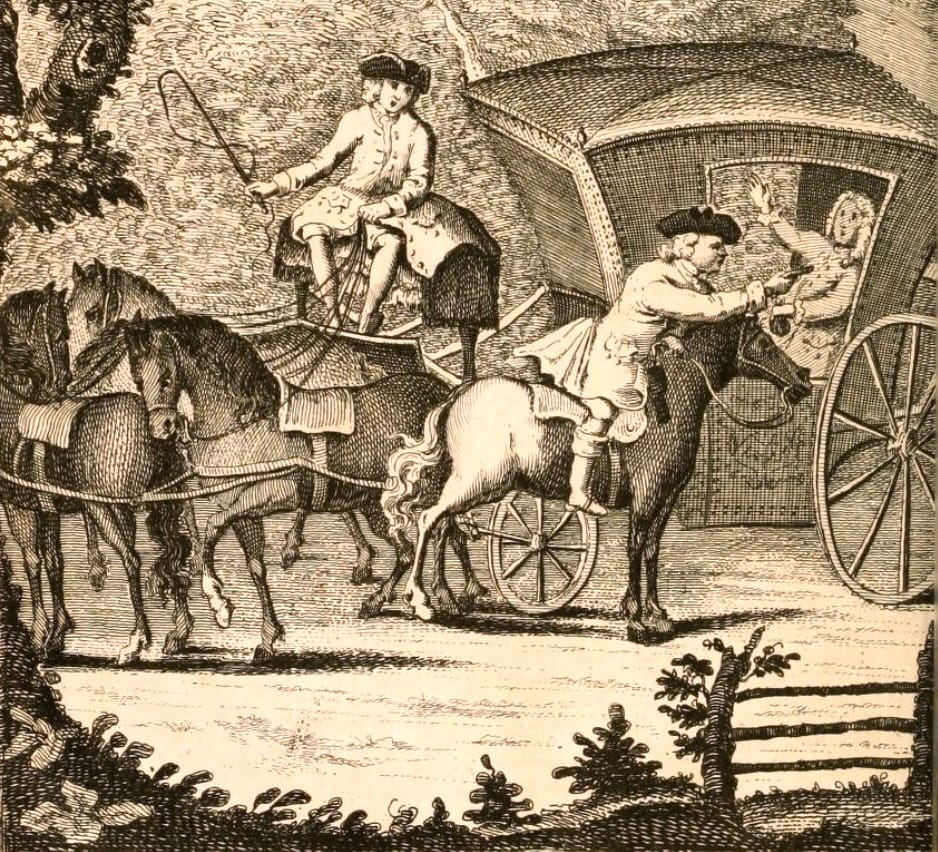
Hind robbing regicide Colonel Harrison near Maidenhead
Hind encountered another regicide during an already profitable morning in Maidenhead Thicket. He stopped Colonel Harrison in his coach-and-six, and relieved him of seventy pounds. Shortly afterwards Hind learned in a safe house that the colonel had procured a hue and cry, so he decided to ride away as fast as he could until he could find some safer way of concealing himself. When he reached Knowl Hill, he heard a man racing up behind him at full speed. Believing he was about to be caught, Hind turned and shot his pursuer through the head; the man fell dead on the spot. But the man was not chasing Hind at all; he was actually one George Sympson, a gentleman's servant trying to catch up with his master to give him an item mistakenly left at home.11 This was said to be the only blood Hind shed during his entire career on the roads, and it was this crime that would eventually lead to his arrest.
Naturally Hind must be seen to parade the requisite courtesy towards the fairer sex. Approaching a coach filled with gentlewomen, he explained pleasantly that it was purely to win the favour of a hard-hearted mistress that he “travelled the country”, a euphemism for holding up coaches. Touched by such knight-errantry, the ladies lamented that they possessed nothing with which to support him in his quest except for three bags each containing a thousand pounds. These, he would understand, they held on sacred trust as the dowry to be delivered to the betrothed of one of their party.
"My humble duty be presented to the knight," said James, "and be pleased to tell him, that my name is Captain Hind; and out of mere necessity I have made bold to borrow part of what, for his sake, I wish were twice as much." At the name of Captain Hind the ladies realised they had been duped, and immediately surrendered one bag containing a thousand pounds. Graciously foregoing the other two bags, the captain wished them all a good journey, and much joy to the bride.
If Hind did take part in the Battle of Worcester, this would put him in London in the days after 3 September 1651. From this point on, dates are confidently assigned to certain events in the various pamphlets, and even names given; this combination allows us to research the degree of accuracy of each one. We are told that Hind left Worcester and escaped to the anonymity of London where he stayed with a barber named Denzel (or Denzie) in the parish of St Dunstan in the East (or St Clement Danes) near Fleet Street. There was indeed a family of similar name in the parish of St Dunstan in 1640: one Ralph Dansle had a daughter, but he was a mariner, not a barber.12 In St Clement Danes one William Denzye was buried in 1682.13 And then, spotted and betrayed by a former comrade who happened also to be in London, Captain James Hind was imprisoned at Newgate in December 1651 where his wife and father supposedly visited him.
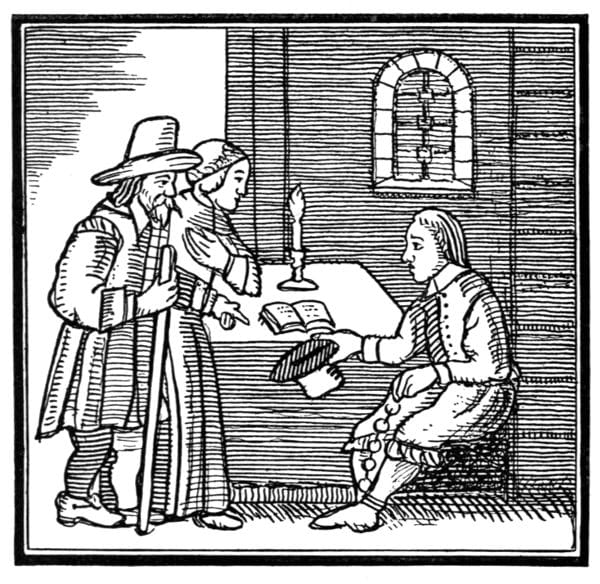
Hind’s wife and father are said to have visited him in 1651
He was brought to the bar of the sessions house in the Old Bailey and indicted for several crimes but, because there was insufficient evidence, he was conveyed in a coach from Newgate to Reading in Berkshire. On the 1 March 1652, he was arraigned before Judge Warberton for killing George Sympson at Knowl. The evidence against him was clear, and he was found guilty of wilful murder, but an Act of Oblivion had been published just a week or so before forgiving all former offences but those against the State. The Act was an attempt by the Rump Parliament during the Interregnum to promote "healing and settling" by forgiving former Royalists who fought against Parliament in the Civil Wars. By an Order of Council Hind, was removed by habeas corpus to Worcester jail.
A degree of judicial acrobatics was still required to achieve a death sentence for Hind. Although he had originally been arrested for the shooting in Maidenhead Thicket, he claimed this was in self-defence. What eventually did for him in the court in Reading was his steadfast declaration of loyalty to Charles I’s son. This was plain treason and Hind was duly sentenced to death. The tear-jerking report of an eleventh hour reunion between James and Margaret and their children cannot be verified. However, it is true that Margaret was still alive, as were Alice, 11, and Charles, 4. But, after their baptisms, the names of the two other sons James and Samuel are not evident in the badly-disfigured register.
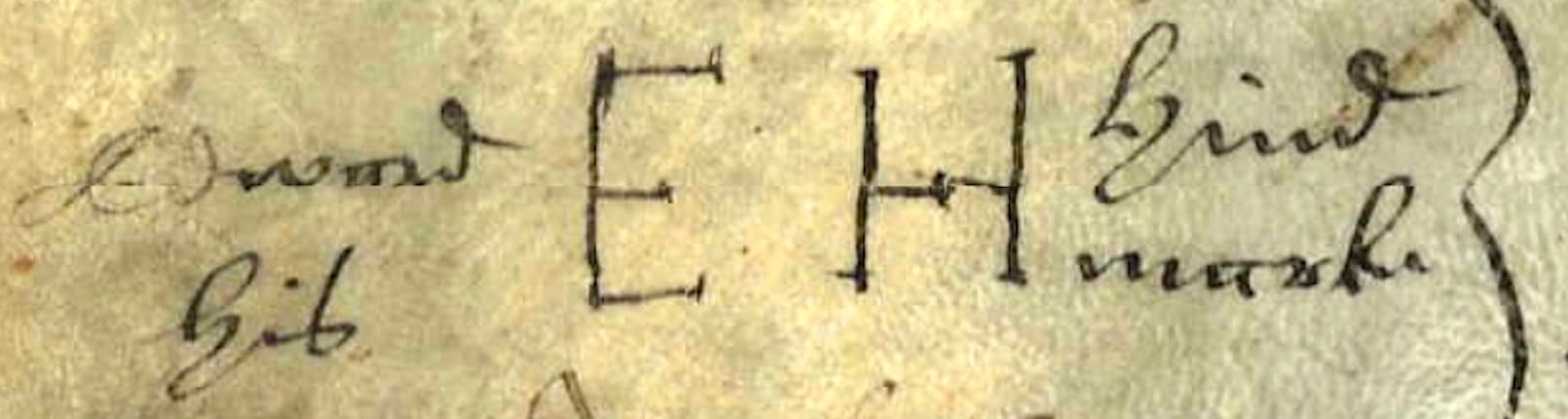
The monogram of Hind’s father appears in the parish register for the last time in 1627
Whether or not James’s parents lived to endure his execution is also unclear. His churchwarden father’s “EH” monogram (with the cross-bar of the “H” altered to resemble a snaffle bit as befitted his trade of saddler) appears in the Chipping Norton register of baptisms, marriages and burials for the final time in 1627. This does not mean that elderly Mr Hind could not have travelled to London to visit James in Newgate gaol in 1651, but it seems unlikely.
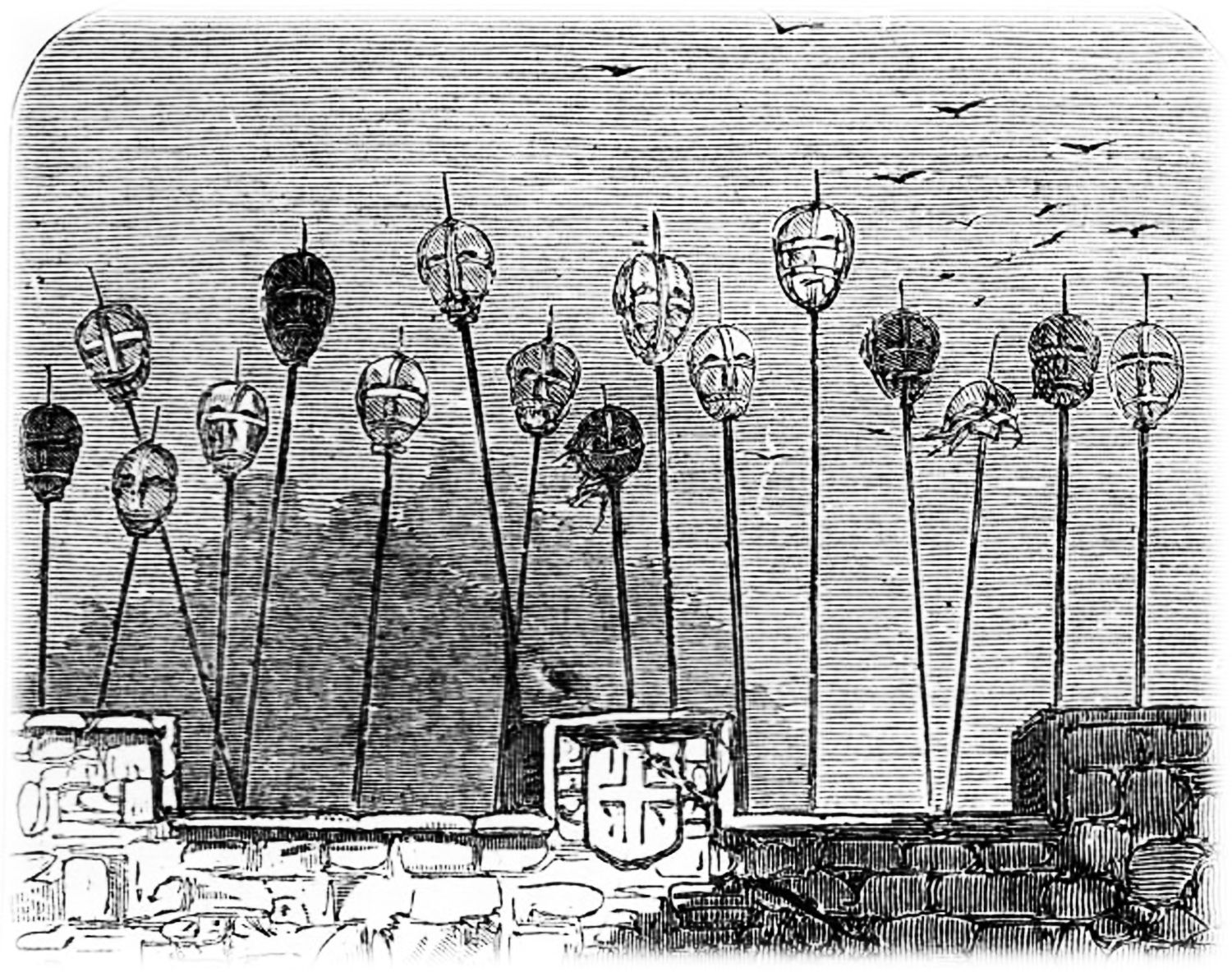
Hind’s head was spirited quietly away
In September 1652, James Hind’s head was stuck on a pike on the Bridge Gate over the River Severn at Worcester. A week later it was mysteriously spirited-away. Margaret Hind did not re-marry; she died in May 1662.15 Alice Hind died “a mayde” in July 1672,16 and her brother Charles died in March 1674.17
• The true and perfect Relation of the taking of Captain James Hind, (London, 1651)
• Hind’s Ramble, or, The Description of his manner and course of life, (London, 1651)
• Fidge, G, The English Gusman, or the History Of that Unparallel'd Thief James Hind (London, 1652)
1 Oxfordshire, England, Church of England Baptism, Marriages, and Burials, 1538-1812, Chipping Norton with Over Norton, 25 July 1616, bap James Hind
2 As indicated in the Chipping Norton baptismal register for 1627.
3 Dictionary of National Biography, London, England: Oxford University Press; Volume 09; Page: 893
4 E.g., Fidge, G, The English Gusman, (London, 1652), pp. [3]–5
5 Oxfordshire, England, Church of England Baptism, Marriages, and Burials, 1538-1812, Chipping Norton with Over Norton, m. 24 Feb 1638
6 Oxfordshire, England, Church of England Baptism, Marriages, and Burials, 1538-1812, Chipping Norton with Over Norton, 27 Oct 1640, bap Alys Hind [sic]
7 Oxfordshire, England, Church of England Baptism, Marriages, and Burials, 1538-1812, Chipping Norton with Over Norton, 4 Nov 1644, bap James Hind
8 Oxfordshire, England, Church of England Baptism, Marriages, and Burials, 1538-1812, Chipping Norton with Over Norton, 31 Jan 1646, bap Samuel Hind
9 Oxfordshire, England, Church of England Baptism, Marriages, and Burials, 1538-1812, Chipping Norton with Over Norton, [illegible] 1648, bap Charles Hind
10 A good summary of the clues inadvertently left by the compositors of these publications can be found at https://webdoc.sub.gwdg.de/edoc/ia/eese/artic27/uboeker/7_2007.html#fu49
11 He is named in some places as “George Sympson”, but I have been unable to trace a burial for a man of that name in the area at an appropriate date.
12 London Metropolitan Archives; London, England, UK; London Church of England Parish Registers; Reference Number: P93/DUN/257, St Dunstan and All Saints, bap 6 Apr 1640, Susanna Dansle
13 City of Westminster Archives Centre; London, England; Westminster Church of England Parish Registers; Reference: STC/PR/7/4, St Clement Danes, London, bur 9 Dec 1682, William Denzye
14 Newgate Calendar, https://www.exclassics.com/newgate/ngintro.htm
15 Oxfordshire, England, Church of England Baptism, Marriages, and Burials, 1538-1812, Chipping Norton, 1 May 1662, bur … Hinde, widow
16 Oxfordshire, England, Church of England Baptism, Marriages, and Burials, 1538-1812, Chipping Norton, 2 Jul 1673, bur Alice Hinde
17 Oxfordshire, England, Church of England Baptism, Marriages, and Burials, 1538-1812, Chipping Norton, 26 Mar 1674, bur Charles Hinde