- Forgotten Lives of Oxfordshire
- Posts
- From Burford to the stake at Tyburn
From Burford to the stake at Tyburn
by Julie Ann Godson
Burning at the stake was a lawful punishment in England for women (and only women) until 1790. This appalling discrimination was justified on the grounds of gallantry; no lady, according to the exclusively male legal profession, would want to be seen twitching grotesquely on the end of a rope – perhaps even exhibiting her ankles and under-garments. It was a question of maintaining the dignity of the female person.

The Royal Oak, just before the Great House on the right
WHEN THE LANDLADY of the Royal Oak in Burford answered an urgent knock at the door in September 1739, it seems unlikely that she expected to find standing there her sister Susanna Broom. Susanna, who lived in London, claimed that she had “heard that her husband was murdered, and there was nothing left for her”, so she had come home to Burford.
The sisters were both Burford born, and both around 60 years old. Susanna was twice married; before her latest husband, at 21 she had married John Barnard from Horsley in Gloucestershire.1 Whether or not the couple had children, or indeed whether or not Susanna had waited for John to die first, by 1706 she had decamped to London and married a Shadwell tailor called John Broom.2 The bride described herself as a spinster, not a widow, so it seems likely that she knew she was committing bigamy. Now, thirty-three years later, she was back in Burford. Why? It would not be so surprising if the first flush of romance had faded in such a long marriage. But there was more to it than that.

Neighbours heard Susanna berating her husband
Neighbours told of noisy, physical fights between the couple, but this was no stereotypical case of wife-beating by a drunken husband. They painted a picture of John as a mild-mannered soul persecuted by a violent and bitter wife. William Allen in the room next door recalled: “She was an obstinate woman, and used to quarrel with him. I have saved him from her a great many times… She was the wickedest woman on Earth.” Mary Mathias at the top of the alley said: “… She has beat him out of doors divers and divers (of) times, and she has sent him divers times to a two-penny lodging… I have seen her beat him out of doors, a great man, and have often called out to her, for God's sake let your husband in!” Mary Coombes from the floor below claimed: “I have seen her beat him several times with the poker, and have heard him cry out Murder!” Where the vicissitudes of life appear to have created of Susanna a veritable termagant, they knocked the fight out of poor John Broom. “There was not a more quiet man on Earth than he was,” insisted Allen.3
Rather than simply accepting from one news story that somebody was inherently wicked, it is always worth exploring the historical record for clues as to why they behaved in the way they did. The poor in the streets around the London docks lived under considerable pressure. They were not yet the brick-built slums of the Victorian era, though. “Seamen, watermen and lightermen, coalheavers and shopkeepers, and ropemakers, coopers, carpenters and smiths, lived in small lathe and plaster or weatherboard houses, two storeys and a garret high, with one room on each floor,” says historian Jane Cox.4
Considerable sadness haunted the family home in New Gravel Lane, along the western edge of the old Shadwell Basin in the docklands of East London. A daughter, Judith, was born in February 1707,5 but she died in September 1711.6 Katharine, born in April 1709,7 died a few weeks later in June.8 In November 1710, Eleanor arrived, but she would not make it to 28, dying in July 1738.9 Little Joseph Broom lived to only three.10 The year after Eleanor’s death, the Brooms lost their daughter Mary at the age of 22.11 And it was in the September of that same year that Susanna murdered her husband. Such a distressing litany does not, of course, excuse taking yet another life, but the loss of so many children might cause a volatile woman’s nerves might fray. There is no reason to believe that parents in the past treated a child’s death any more casually than they do today, and living with an excess of grief over a long period may cause a person suddenly to snap.
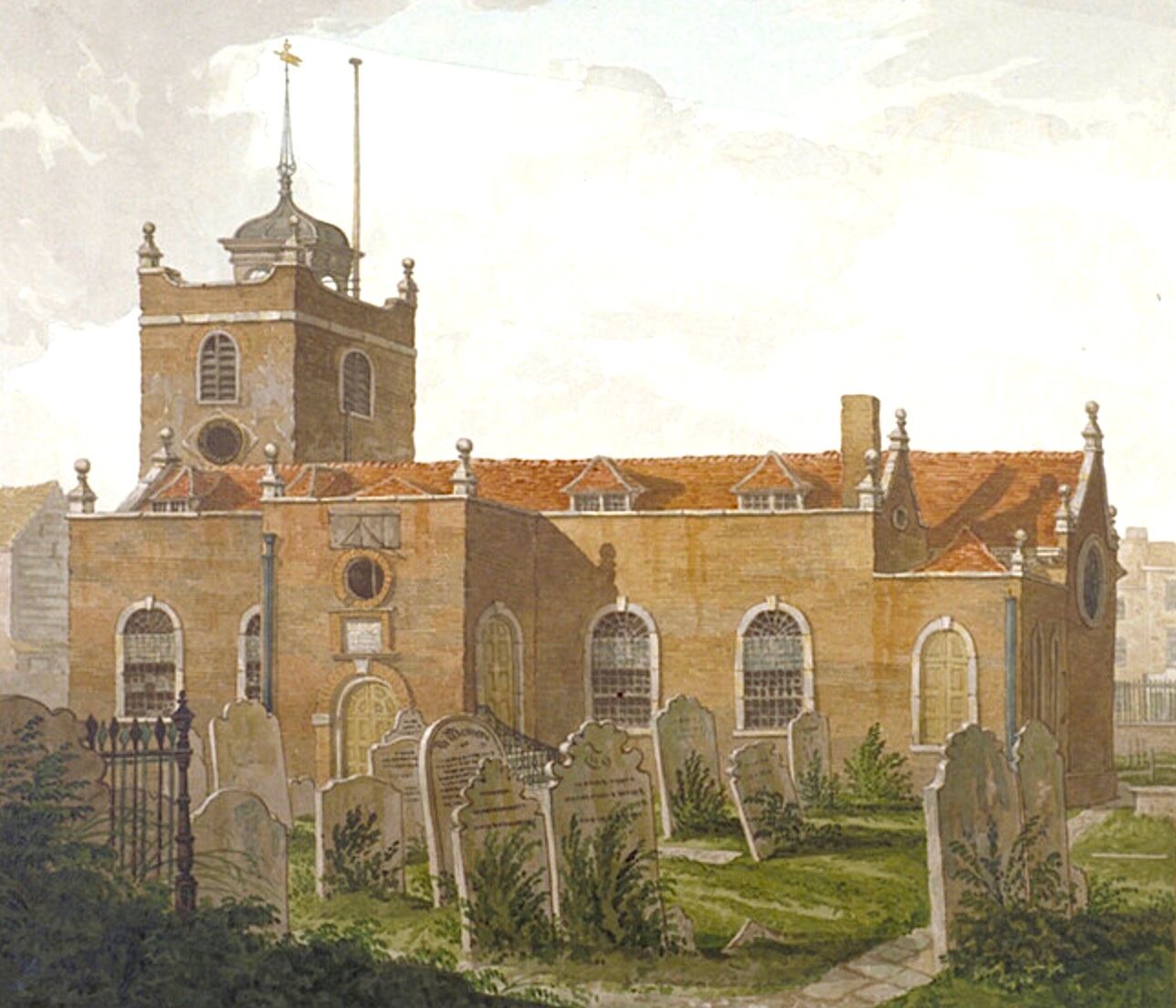
The Church of St Paul, where so many Broom children were buried
At around one or two o’clock in the morning on 11 September 1739, neighbour William Allen heard John Broom cry out: “For God's sake don't murder me! For Christ's sake don't murder me! Several times he (thus) cry'd out, but I did not go out of my room, for she was an obstinate woman, and used to quarrel with him.”12 Evidently this kind of rumpus in the Broom household was not so unusual as to create alarm.
Martha Eaton ran a shop at the end of the road. She recalled that Susanna came in at about three in the morning to buy a farthing candle. Her face, arms, and head were covered in blood, but showed no actual wounds. Asked whether her husband had been beating her, Susanna said yes, and after forty years of marriage and seventeen children.13 (Including her first marriage, Susanna had been married for thirty-six years. She may have been including pregnancies that did not reach full term in her tally of children.)
The neighbours went to investigate, and Susanna Anderson described the scene. “About ten o'clock in the morning after the man was killed, Mr Mangham, who lodged in the same house with the prisoner and the deceased, told me he believed Mr Broom was murder'd, and that his wife had kill'd him; and he desired the neighbours to open the door. They did so and I went upstairs with them, and found the deceased lying on his back, upon the bed, but his legs hung down and his feet were on the ground. He was cold and stiff but his eyes were open, and he was cut in a very vile manner. There was a great cut cross the calf of his right leg (I think), 'twas almost to the bone, two great wounds in his thigh, several upon his shoulders, and a cut across his belly as if he had had a great scratch with a large pin.”14 Together with reported cuts on John Broom’s hands, which indicated that he had been attempting to defend himself from a knife attack, the cuts to the back of his legs suggest that he was trying to get away, and was more likely the victim than the perpetrator.
“All his cloaths [sic] were upon him except his shirt, and there was no blood upon him for he seem'd to have had his wounds wash’d,” continued Mrs Anderson. “The prisoner was not in the house when we view'd the body; I saw her go out in the morning, about seven all over bloody… Tho' there was no blood upon the deceased, yet there was so much upon the floor that as soon as I had stepp'd into the room the blood was over the sole of my shoe. The bolster, the sheets, and the blankets were likewise all over blood. This cap and this handkerchief I found on the farther side of the bed, [they both appear'd as if they had been dipped in blood] I know them to be the prisoner's, and have seen her wear them.”15
The surgeon who attended, William Brown, testified that the wounds were inflicted by a knife. Mary Coombes recalled that Susanna “was a mighty woman for carrying a pen-knife with two blades, which she valued very much, and said, she had a great respect for that knife, and it would do her good service.”16 Susanna was charged with murder, but she had already fled.

Burford Priory, home of Sir John Lenthall
It was either by staggering coincidence, or more likely in hopes of a reward, that another Anderson – William – found himself in Burford a few weeks later when, he says, he spotted Susanna Broom in the street. He was very likely another neighbour from Shadwell, married to the witness Susannah Anderson.17 He claimed: “She was going thro' the town, and I knew her and seized her. I had been in London about a week after the murder, and had heard that she was charged with it; and seeing her in Burford about three weeks after, I took her before 'Squire London18 , and there she said she heard that her husband was murdered, and there was nothing left for her, tho' she should have gone to see after him. She told me he was always quarrelling with her, and she found a pen-knife in the bed with him when she went that night to bed. I took her from her sister's, at the Royal Oak at Burford.”19

The Bocardo gaol at the north gate in Oxford
Charged with the murder of John Broom, Susanna was committed to the Bocardo gaol in Oxford where she remained until December.20 On 2 December she was taken by habeus corpus to Newgate gaol in preparation for her trial at the next sessions.21 On 5 December she was sentenced to be burned at the stake for “petty treason”; since the murder of a husband by a wife at the time indicated a willingness to disobey her lawful master, it was treated like any other treasonous act. Only in 1828 was the act of husband-killing by a wife re-classified as ordinary murder.

A condemned man stops for a drink on the way to Tyburn
On the next hanging day, Friday 21 December, the usual procession set off for the journey to Tyburn – ten male prisoners to be hanged were transported by horse-drawn open cart, Susanna was drawn to the site on a hurdle. It was about three miles (5 km) from Newgate to Tyburn but, as the streets were often crowded with onlookers, the journey could last up to three hours. The cart usually stopped at the Crown Inn22 public house in St Giles High Street. This was the "halfway house". Here the condemned were allowed to drink strong liquors, wine, or strong ale, although it is not clear how Susanna could have availed herself of this privilege when lying flat on a hurdle. At Tyburn, the men were prepared by public executioner John Thrift and his assistants and launched into eternity together as the carts were drawn from under them. Susanna Broom was led to a stake that had been set up near the gallows.

A woman would be choked with a rope before burning
Twenty years later, University of Oxford legal expert Sir William Blackstone assured the nation that, except by accident or negligence, there were very few sentences of burning carried out without the convicted woman first being “deprived of sensation by strangling”. Whatever were her crimes, we can only hope for the sake of Susanna and her remaining children that this practise was already current in 1739.
With thanks to Lucy Bennett.
Julie Ann Godson’s books are available at Amazon.com.
1 Oxfordshire, England, Church of England Baptism, Marriages, and Burials, 1538-1812, Burford, 7 Apr 1703, John Bennet m Susanna Higgens [sic]
2 London Metropolitan Archives; Church of England Parish Registers; Reference Number: P93/PAU3/016, 19 Nov 1706, St Paul, Shadwell, John Broom m Susannah Higgins
3 Old Bailey Proceedings Online (www.oldbaileyonline.org, version 9.0) December 1739. Trial of Susannah Broom (t17391205-2). Available at: https://www.oldbaileyonline.org/record/t17391205-2?text=%22susannah%20broom%22 (Accessed: 16 September 2025)
4 Cox, Jane, Old East Enders: A History of Tower Hamlets, History Press (November 2013)
5 London Metropolitan Archives; Church of England Parish Registers; Reference Number: P93/PAU3/001, St Paul, Shadwell, 1 Feb 1707, bap Judith Broom
6 London Metropolitan Archives, Church of England Parish Registers, 1538-1812, Tower Hamlets, 10 Sept 1711, bur Judy Broom
7 London Metropolitan Archives; Church of England Parish Registers; Reference Number: P93/PAU3/001, St Paul Shadwell, 26 Apr 1709, bap Katharine Broom
8 London Metropolitan Archives; Church of England Parish Registers; Reference Number: P93/PAU3/034, St Paul, Shadwell, 10 Jun 1709, bur Katharine Broom
9 London Metropolitan Archives; Church of England Parish Registers; Reference Number: P93/PAU3/035, St Paul, Shadwell, 12 Jul 1738, bur Eleanor Broom
10 London, England, Church of England Baptisms, Marriages and Burials, 1538-1812, St Paul Shadwell, 9 May 1721, bur Joseph Broom
11 London, England, Church of England Baptisms, Marriages and Burials, 1538-1812, St Paul Shadwell, 16 Feb 1739, bur Mary Broom
12 See note 3
13 See note 3
14 See note 3
15 See note 3
16 See note 3
17 London Metropolitan Archives; Church of England Parish Registers; Reference Number: P93/DUN/269, Stepney, 7 Sept 1702, William Anderson, cordwainer, m Susanna Coster
18 Actually John Lenthall of Burford Priory
19 See note 3
20 Kentish Weekly Post or Canterbury Journal, 24 October 1739
21 Stamford Mercury, 6 December 1739
22 Now re-built as The Angel