- Forgotten Lives of Oxfordshire
- Posts
- A Romany life
A Romany life
by Julie Ann Godson
Gypsies were once an integral part of rural life, providing services to largely static country villagers. A housewife in need of a new set of pegs, sharpened scissors or a mended saucepan knew that the local tribe with all the necessary skills would arrive before long. Regular agricultural work like fruit picking came round like clockwork, and ensured a welcome for the travellers. But their peripatetic lifestyle and distrust of authority makes it difficult for researchers to trace their lives.

Noah Butler, plus ccompanions [photo courtesy Teresa Fox]
One character frequenting Oxfordshire’s roads over a period spanning the 1870s to the 1960s was umbrella-mender and peg-maker Noah Butler. He lived his life according to the old Romany ways, so following his movements is a good way of rediscovering traditional routes that would soon fall out of use. The census has never been a satisfactory method by which to track the movements of travelling people. But the paper trail created by Noah’s various legal difficulties does permit us a glimpse into this secretive world. Late summer, of course, was spent in Kent helping to harvest hops and fruit, but then it was back to the specific circuit frequented by the Butlers and their allies.
In June 1900, PC Elderfield was tipped off that there was a family of gypsies camping in Barley Lane in Barford St Michael.1 At midnight Elderfield found Noah and his wife and child sleeping on straw inside a tent in the lane, and he informed Noah that he must arrest him. Noah protested that he had been there for only a few minutes; however the fact that the horse was already unharnessed from the cart and happily grazing the verge suggested otherwise. In Deddington, Noah explained to the Justice of the Peace that he was sorry, and that if it hadn't been for the terrible storm, he would have made it to the Gate Hangs High public house. The Justice said that it was the magistrates' duty to put a stop to "that kind of thing", and that if there were any further offences, the defendant would be fined heavily or go to jail. Noah was imprisoned for one day – the kind of sentence that allows the justices of the peace to acknowledge that an infringement has occurred whilst at the same time admitting the sheer pointlessness of the exercise. Because, of course, there would be many, many more offences of that sort in a world less and less tolerant of lives lived outside of the norm.
Noah Butler was a young man of 25 years at the time of this first reported run-in with the law.2 Whether or not the woman in the tent was officially his wife is difficult to say, but certainly Louisa Biddle from Spelsbury proved a loyal companion to Noah throughout his life. The child would have been one of the couple’s two daughters, Naomi and Louisa.
Five years later it was January when PC Barrett spotted an unattended horse and cart on the top of Armscott Hill at Tredington, north of Shipston on Stour. Upon the officer’s return there still appeared to be nobody in charge, although a small child, probably Naomi, could be seen some way off. Noah failed to attend the hearing, so Louisa paid the five-shilling fine.3
In March 1907, again north of Banbury, Noah made a silly mistake. Radway Grange is a Gothic-Revival country estate situated at the foot of the Edge Hill escarpment, south-east of Kineton. A brass sundial generally to be found on a pedestal on the lawn in front of the house somehow came into Noah’s possession, whereupon he took it to a Banbury antique dealer. The pair haggled, and eventually the antique dealer paid Noah a sovereign.4
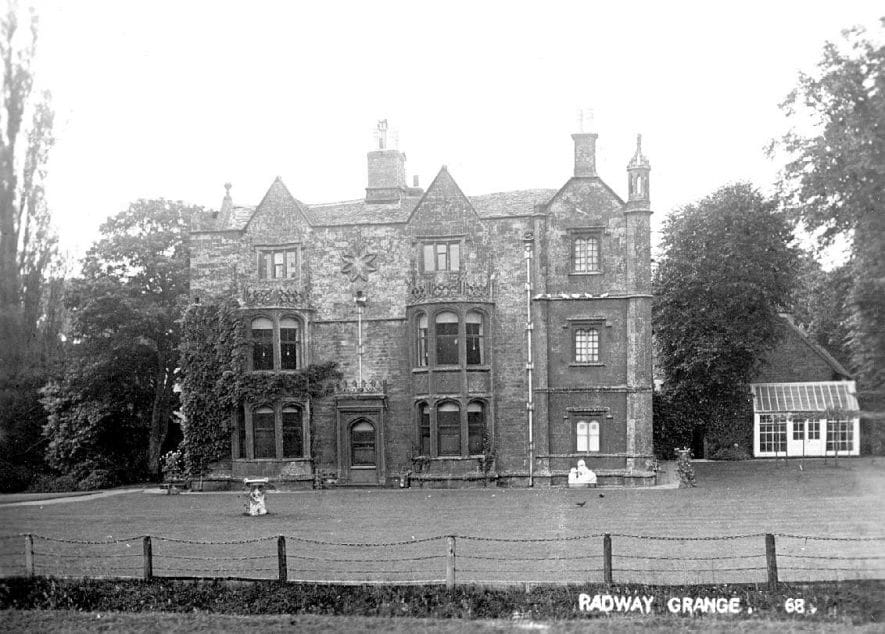
Radway Grange, complete with sundial
Asked by Inspector Smith at Kineton police station how he came by the sundial, Noah claimed he found it thrown down a bank near the pub; he was guilty of “finding it and selling it, but not guilty of stealing it”, he said. However, he offered generously to plead guilty to stealing it in order to settle the case there and then. The magistrates gaoled him for three months.
We next locate Noah at the end of the same year in Bloxham. By 6.30pm on a December afternoon, he and a hawker colleague were already intoxicated and using bad language in the White Lion. By the time a policeman arrived to eject the troublesome pair, they had been thrown out by the landlord once already.5 A game of “tip-it” in the Joiner’s Arms, also in Bloxham, in June 1909 cost Noah a fine for leaving his pony and trap unattended in the road outside.6 The newspaper report on this case mentions another of Noah’s talents: peg-making.

Centre: The White Lion, Bloxham
With his fines mounting, Noah was presumably busy turning out those pegs at a frantic rate between the autumn of 1909 and December 1911 because his court appearances tailed off. But at the end of 1911 he was in North Leigh, being turned out of the Leather Bottle public house and acquiring another fine.7 Almost five years passed before Noah next sinned. By now he was at Sibford Ferris allowing his horse to stray on the road near the Gate Hangs High public house (five shillings), leaving a two-wheeled cart unattended in the road for a week (five shillings), and sleeping under a cart while allowing a horse to stray with its legs tied together near Mr Tustain’s farm (two and sixpence). Police constable Breakspeare remarked somewhat gratuitously that Noah was “no sooner removed from one place than he went to another”.8 The modern world was beginning to bear down on traditional gypsy life.
Spelsbury provided the venue for Noah’s first-ever appearance in the UK Census.9 He described himself as an “umbrella maker”, and Louisa gave her surname as Biddle, not Butler. Living with the couple was their four-year-old grandson, Albert Stratford.
Two horses – one of them blind – were allowed to stray in the road at Swalcliffe in May 1922; roadside camping was blatantly practised in Chadlington in April 1926; and when in October 1929 a notice prohibiting roadside encampments in Salt Lane in Banbury was pointed out to Noah, he countered sweetly that he could not read.10
It was a huge Biddle family funeral rather than the regular Romany peregrination that took Noah, by now 62, and Louisa to St Mary’s church in Banbury in the autumn of 1936.11 Perhaps because his days of crime were over, we learn little of Noah’s travels after this until 1960 when his lifelong companion Louisa died in Hook Norton at the age of 82.12 Following this blow Noah stayed put, watched over by relatives.
Then early one morning in October 1963, flames were seen to be shooting from a gypsy caravan in a field off the Sibford Ferris road. Some passing workmen rushed to the scene but the fire was already out of control, and by the time the firemen arrived “all that remained was a smouldering heap of old iron pots, springs, bed ends and wheel rims”.14 Among the wreckage was found the body of old Noah Butler, aged 89.15 Was this what he intended?

Police study the wreckage of Noah’s caravan after the fire
The Romany ritual of burning the caravan and all the belongings of someone who has died was still well-known, if rather unnerving, to settled country people at this time. At the inquest, Noah’s son-in-law Geoffrey Hillman told the coroner that Noah had always wanted his caravan burned in the traditional fashion after his death.
While gypsies usually lit fires outside their wood and canvas homes, Mr Hillman admitted that Noah had become accustomed to lighting one inside, and moreover that he had caused two previous caravan fires in this way. The coroner suggested that, since nobody heard a sound, Noah likely died from carbon monoxide poisoning before the flames even reached him. Thus ended one of the last traditionally-lived Romany lives of our area.
Cataloguing Noah’s low-level mischief in this fashion gives an impression of continual law breaking. But, apart from the regrettable incident at Radley, the laws he was breaking were mostly around the disposition of his caravan and horses. Many settled residents could more than match Noah’s record for overdoing the drink. These days the gipsy contribution made by families like the Butlers and the Biddles falls to cheaper foreign workers. Outsourcing manufacturing to the Far East has made it uneconomic to have an old pair of scissors mended when you can buy new ones for less. Imported labour desperate enough to accept low wages mops up the back-breaking work of the countryside. Our mania for throwaway consumer goods and our disdain for hard agricultural labour have led us all to contribute to a gradual shrinking of the useful role in society once played by Romany people like Noah Butler.
• These footnotes show how I gathered the information to put this article together. County residents with an Oxfordshire Libraries card can obtain access to historic newspapers and family research websites at no charge in the county’s libraries: https://libcat.oxfordshire.gov.uk/web/arena/join
1 Oxford Times, 16 June 1900
2 Worcestershire, England, Church of England Births and Baptisms, 1812-1922, Wick near Pershore, Worcs, 12 April 1874, mother Martha Butler, “Gipsy”
3 Banbury Advertiser, 12 January 1905
4 Banbury Guardian, 28 March 1907
5 Banbury Advertiser, 19 December 1907
6 Banbury Advertiser, 03 June 1909
7 Oxfordshire Weekly News, 20 December 1911
8 Banbury Advertiser, 21 September 1916
9 National Archives of the UK (TNA); Kew, Surrey, England; 1921 Census Returns; Reference: RG 15/7531, ED 8, Sch 102; Book: 07531, Spelsbury, Oxfordshire
10 Banbury Advertiser, 11 May 1922
11 Banbury Guardian, 29 October 1936
12 Banbury Guardian, 28 January 1960
13 Banbury Guardian, 3 October 1963
14 The newspapers report Noah’s age as 92, but documentation shows that he was actually 89. (See note 2.)
15 Banbury Guardian, 24 October 1963