- Forgotten Lives of Oxfordshire
- Posts
- A Polish village in an English wood
A Polish village in an English wood
by Julie Ann Godson
Where to house foreign refugees fleeing from oppression when Britain doesn’t even have enough homes for its own population? After the Second World War rapid solutions had to be found, and in 1948 Checkendon Camp was acquired from the MOD by the National Assistance Board and turned into a hostel for displaced Polish families arriving from the Middle East and Africa.
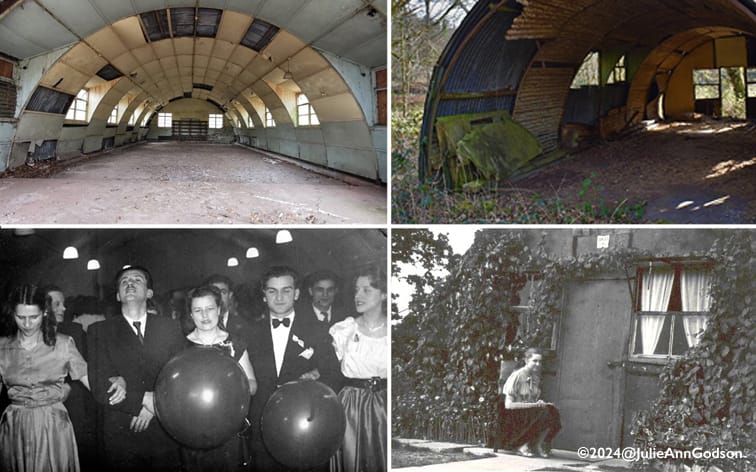
Checkendon Camp: a Polish village in an English wood
SITUATED AT Scot's Common, the camp was located about a mile north of the village of Checkendon in Oxfordshire. Thought to have been built around 1942, it served as a base for US soldiers in the run up to the D-Day landings. It was later used as a hospital and then a prisoner of war camp for German and Italian soldiers. But after the war, with their homes destroyed and their homelands under the control of the Soviet Union, millions of eastern Europeans found themselves in displaced persons' camps around Europe, waiting for the time they could return home.
As with all wartime camps and hostels, accommodation at Checkendon was basic – corrugated Nissen huts and ablution blocks – but after nearly eight years in exile, Polish people soon adapted to their new conditions. Checkendon became one of many bustling Polish enclaves with its own church and priest, school and entertainments in a hall where culture and traditions were lovingly observed.
Many of the 2,500 residents were actively involved in the camp’s social life; there was a lively amateur dramatics group performing plays, a choir that sang both Polish and English songs, and a traditional dance group. A six-person band played regularly at dances in the hall, and weekly films were shown there too. A well-stocked library offered both Polish and English books, there was a youth club, a table tennis club and a chess group. Many residents found jobs locally, and some settled in the area for good.
Says former resident Czeslaw Adamczyk: “My parents Rozalia Leszcaynska and Jan Adamaczyk met and married in Checkendon Camp. I was born in 1955 in Battle Hospital, Reading, as were my brothers. We lived in Checkendon until 1959 when we moved to Reading. Naturally the first language I learned to speak was Polish and, whilst I still speak it fairly fluently, once we moved to Reading and I started making friends with children in the neighbourhood, English very quickly became my first language.
“My father worked at a car plant in Oxford about twenty miles away. There was a bus station on the camp and sometimes we would travel by bus to Reading about ten miles away. I remember that we used to keep chickens and rabbits. Only recently, at my mother’s funeral, I was reminded by some women from my mother’s generation how they used to see me making my way to my grandmother’s Nissen hut carrying my egg, being ever so careful not to drop it, for her to cook it for me for breakfast while my mother went to work in the shop on the camp.
“Another story which my mother told me was about when we went to visit a friend of hers who had moved to Sonning Common, about five miles away, and lived in a ‘proper’ house, unlike us who lived in a Nissen hut. I was so taken by the fact that our friends had pretty wallpaper on their walls that when we returned, I wanted to tear down the tar paper that lined the walls of our hut saying we should replace it with nice wallpaper."

Baby Zbigniew Karpowicz and his family outside their home at Checkendon
Zbigniew Karpowicz (pictured above as a baby) and his wife Basia spent their early childhoods living there. Now, alongside their friend and local history enthusiast Graham Drucker, they are hoping to trace others who lived in the camp, or in a nearby one at Nettlebed. Mr and Mrs Karpowicz were both born in the camp and christened in the chapel there. They recall "lovely" memories of the site, including playing in the bluebell woods and walking to nearby Checkendon to go to the post office.

Inside the chapel [photo: Czeslaw Adamczyk]
"For children this place was really quite idyllic. It was a Polish village in the middle of the beech woods," said Mr Karpowicz, now 70. But he said for his parents and grandparents, who lived in Checkendon for twelve years following a turbulent time in their nation's history, the experience was different. "This was just another temporary place where they would live… like a road to nowhere," he said.
Army veteran Waldemar Daniel Textor came to the UK as a refugee after Poland was taken over by the Soviets. He travelled to England on the troop ship Enterprise. He joined the Polish resettlement corps in England in December 1946 and was discharged in October 1948. Waldemar worked on the farm at the Black Horse, which was owned by Albert and Maggie Saunders. He was part of a strong community of Polish people who lived in and around the camp. His son Richard Textor said: “He had been granted permission to emigrate to Canada and join his brother Alec, but Mr Saunders had become very ill and he decided to stay at the Black Horse looking after the farm. He worked there until he retired.”1
The camp finally closed in 1961. What happened to the site after the refugees left? Rentokil had a wood-treatment plant there – hence the apparently spooky photos of chemicals that sometimes pop up on the internet. So-called urban explorers seem to feel the need to make these places look as if unspeakable experiments were conducted there. However, eye-witness evidence suggests that the camp was a place of relief and joy, and full of happy memories for the children who grew up there. It is now on the edge of a timber yard. Only three Nissen huts and three buildings remain, and eagle-eyed developers would no doubt be keen to exploit its use in the Rentokil days as "light-industrial".
Despite the site's important history, Graham Ducker says there is virtually nothing left of it – just a few abandoned Nissen huts and, for the eagle-eyed, carvings left on some of the surrounding trees. "It's not even a ghost town – just isolated ghosty buildings." He adds that there are "next to zero" in the way of official records about the site and the people who lived there.
"Checkendon and its history has been forgotten," he said. He hopes to install a monument or plaque to commemorate the camp and those who lived and served there.
1 Henley Standard, 31 Jan 2022